Building a Custom CRM for Transparency Language

PROJECT BY QUALIX SOLUTIONS

Revolutionizing Business Operations for Transparency Language

Transparency Language is a professional language service agency offering high-quality translation and interpretation services. With a focus on customization, they support businesses with quick responses and specialist services, including localization, editing, proofreading, transcription, language technology, and quality assurance (LQA). To date, Transparency Language has supported over 6,000 brands worldwide in industries like technology, marketing, legal, and finance. 

Challenges Faced by Transparency Language

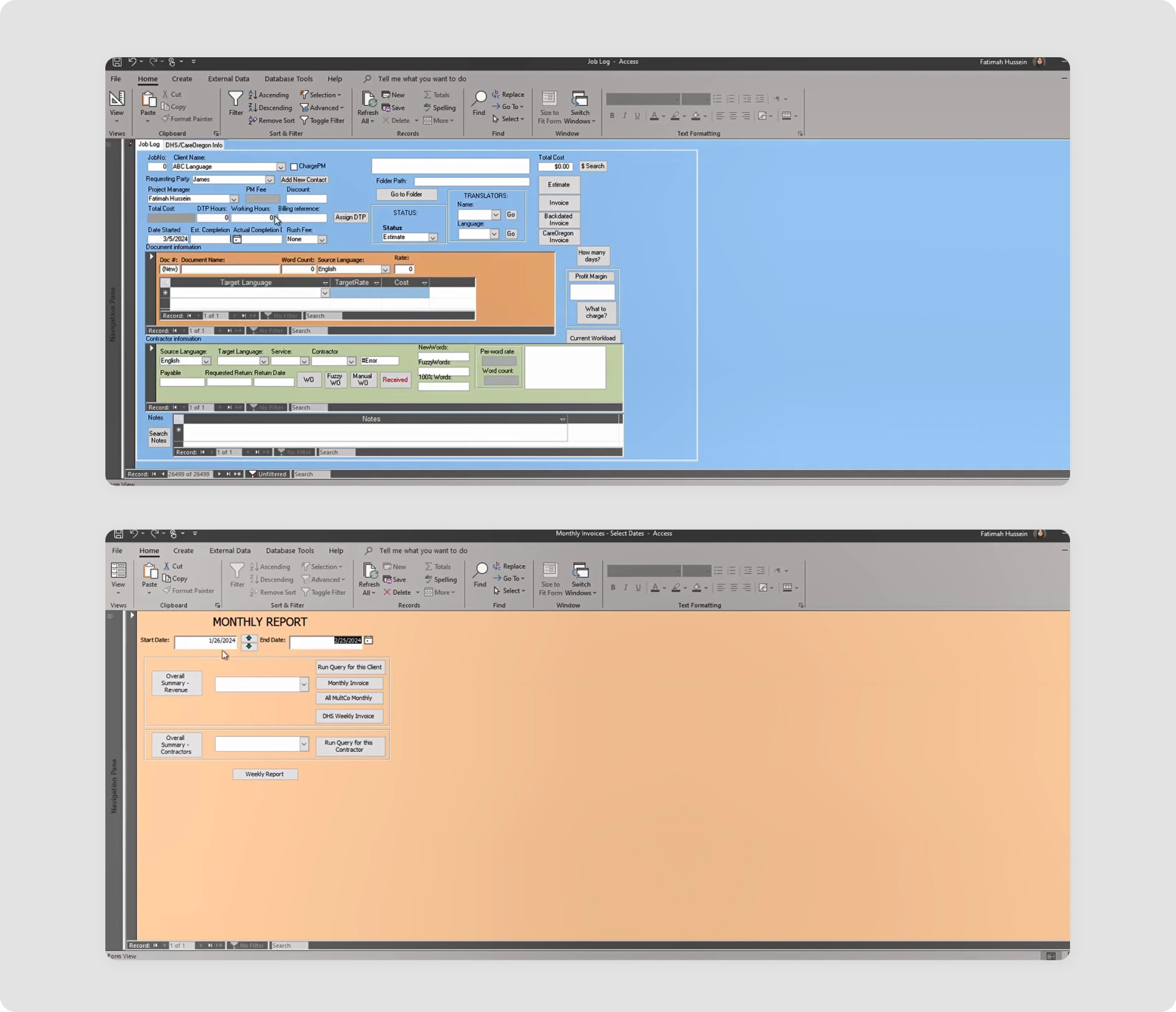
  • Currently, the client manages all customer information manually through Microsoft Access.
  • They also manage their interpreters and translators, including pay, using Microsoft Access.
  • The client wanted to move away from manual processes and automate their business operations.
  • Assigning jobs to interpreters and translators was done manually, leading to inefficiency.
  • Communication with employees, translators, and interpreters was scattered and inconsistent.
  • They required a CRM that could manage all aspects of their business seamlessly.

Gathering Requirements and Understanding Client Needs

Transparency Language’s key requirements were: 

    1. A quote form for interpreting and translation services that clients can fill out when requesting services.
    2. The ability to receive queries in their CRM, where an admin would analyze the request and send an estimate to the client.
    3. Once a quote was approved, the admin needed the ability to assign the service to the appropriate interpreter or translator.
    4. A process to track when the service was completed and when the client approved it.

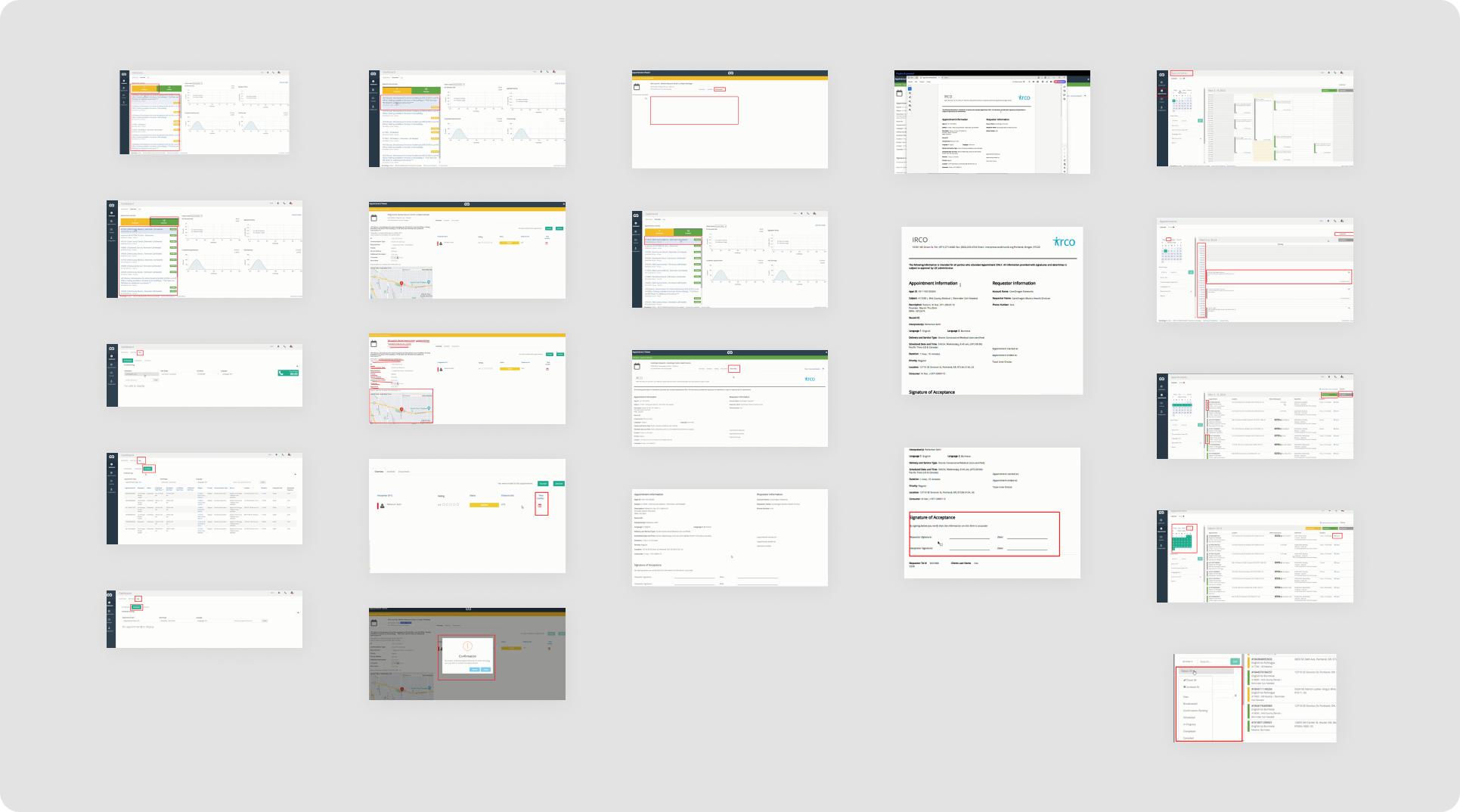
Competitive Research to Understand Market Landscape

To create a unique and effective solution, we conducted in-depth research into Transparency Language’s competitors. Our findings revealed that their main competitors were: 

  1. Boostlingo
  2. Smartling

Crafting the User Flow

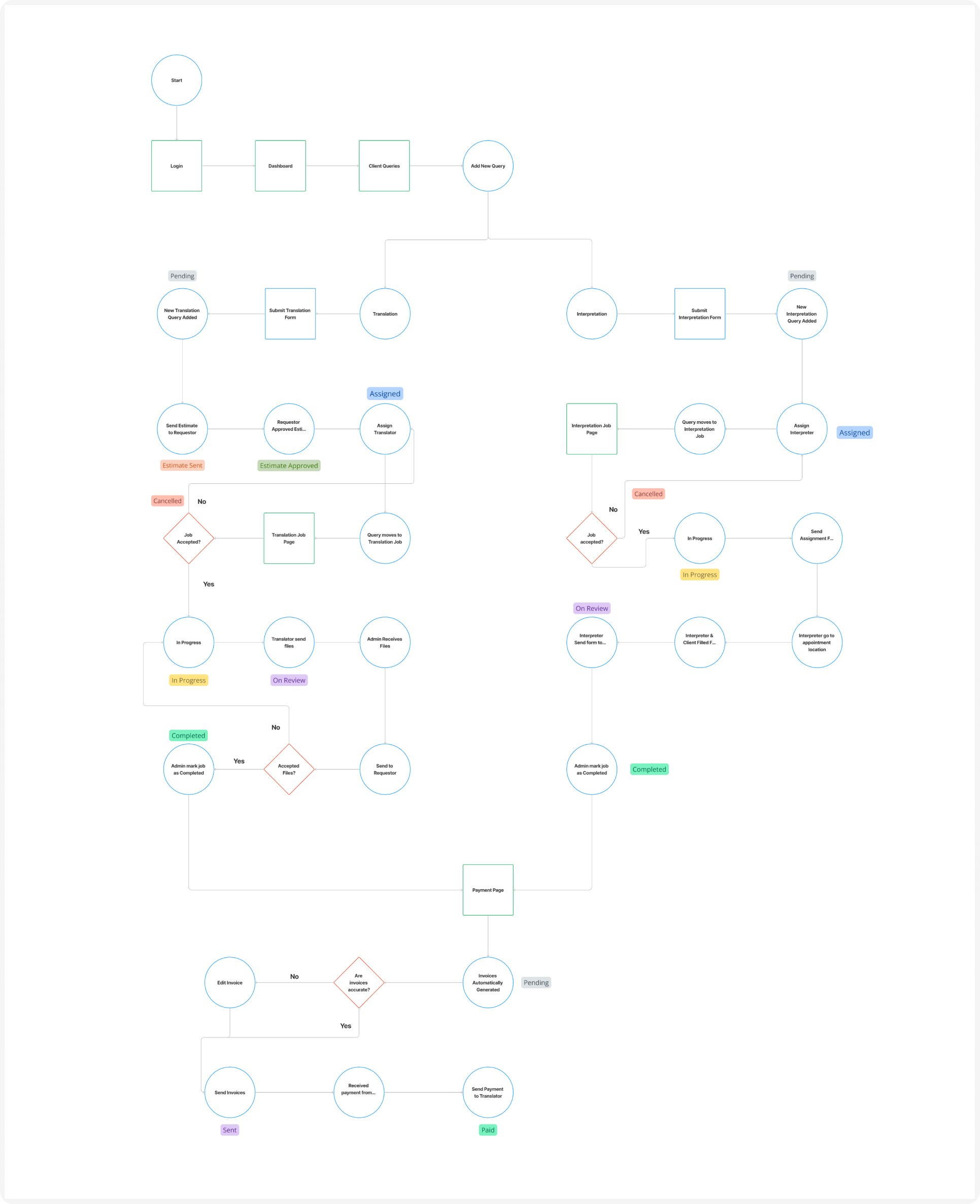
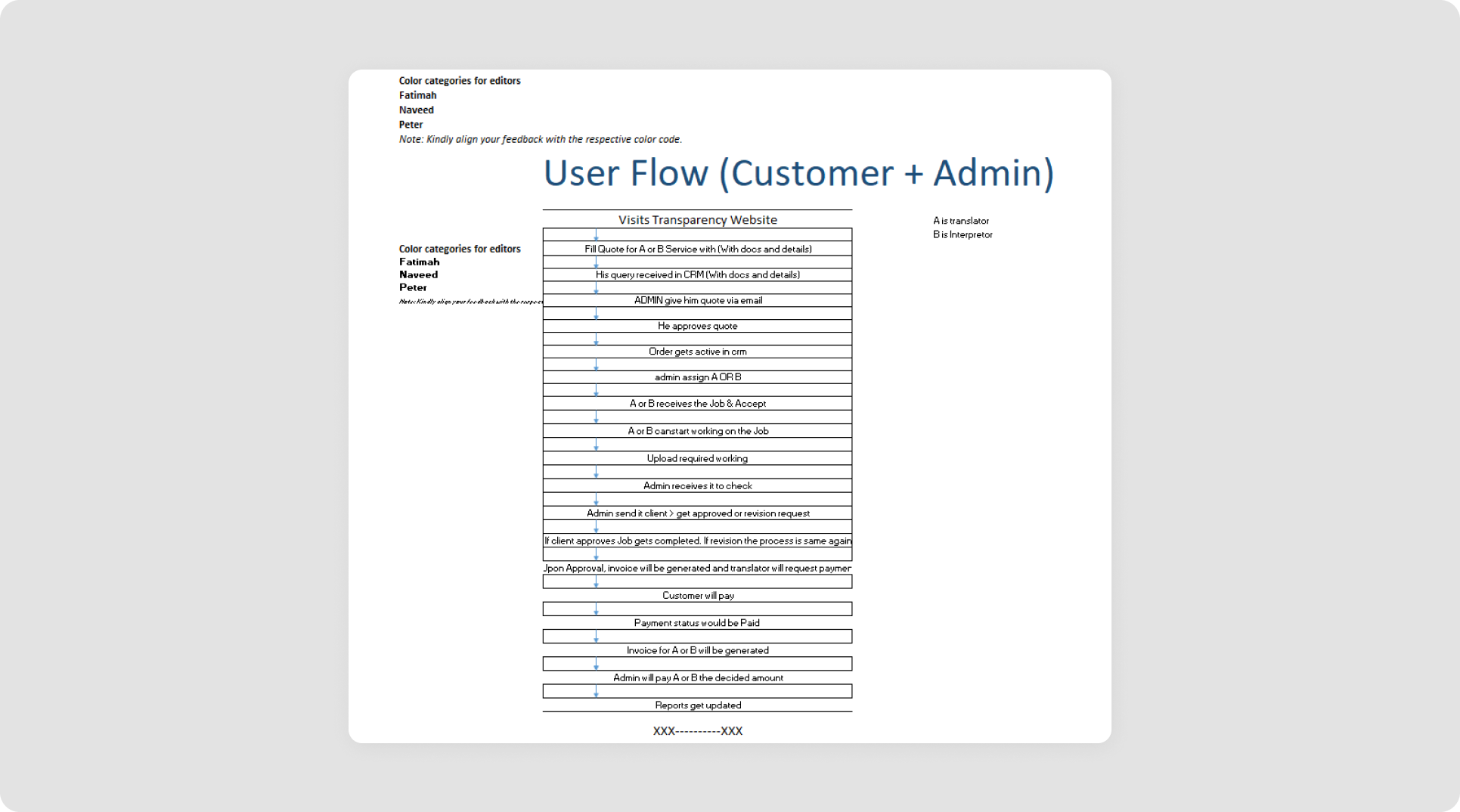
We developed a comprehensive user flow that mapped out the journey from receiving a client request to assigning jobs and completing the service. This flow outlined the steps the admin would take to manage queries, assign interpreters or translators, and ensure job completion. 

Wireframes to Provide Structure and Clarity

After the competitive research, our UX designers crafted low-fidelity wireframes, highlighting the essential screens and user interactions for Transparency Language’s CRM. These wireframes were shared with the client for feedback and iterative improvements were made based on their insights. 

Creating the First Look and Feel of the Dashboard

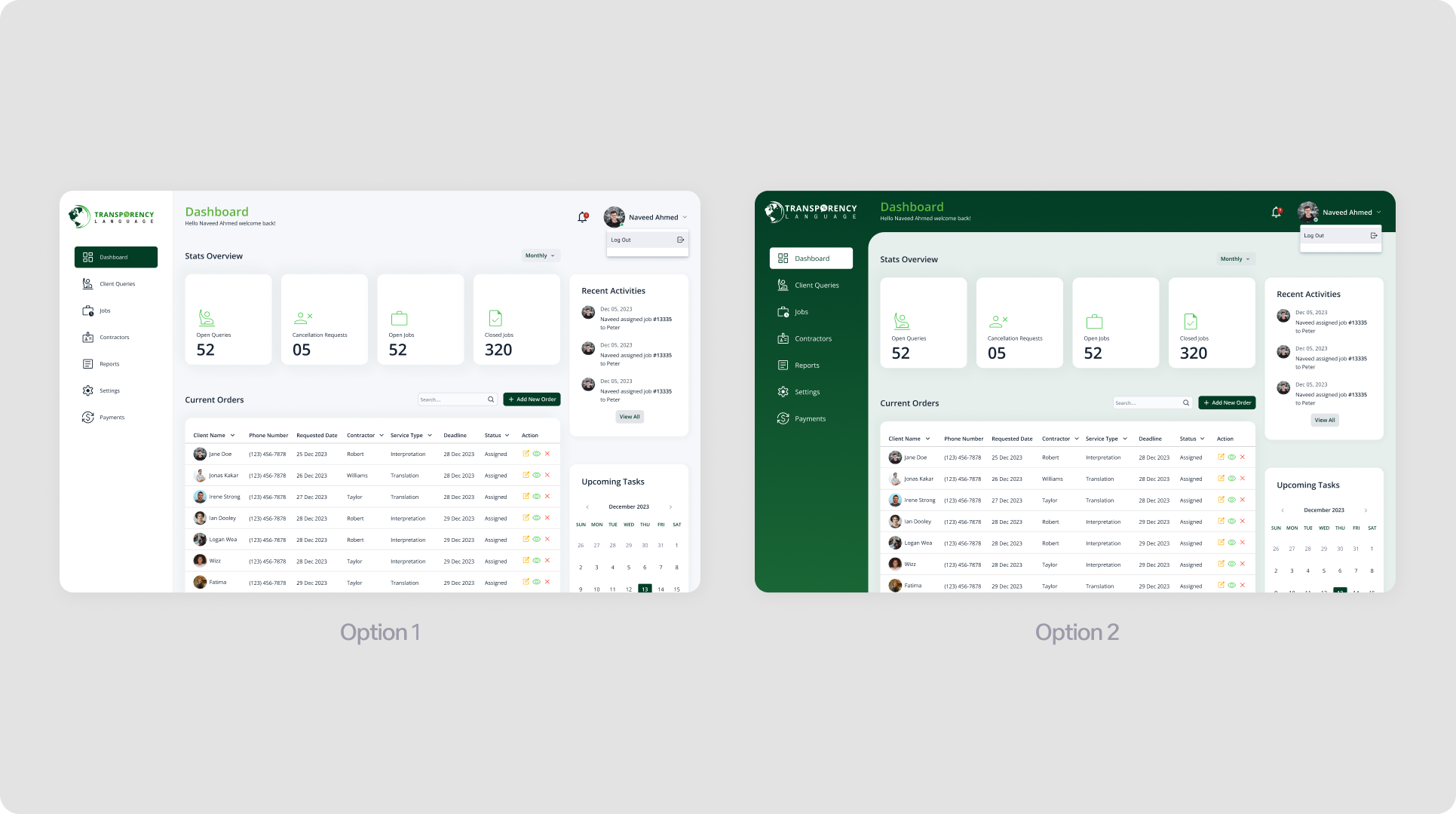
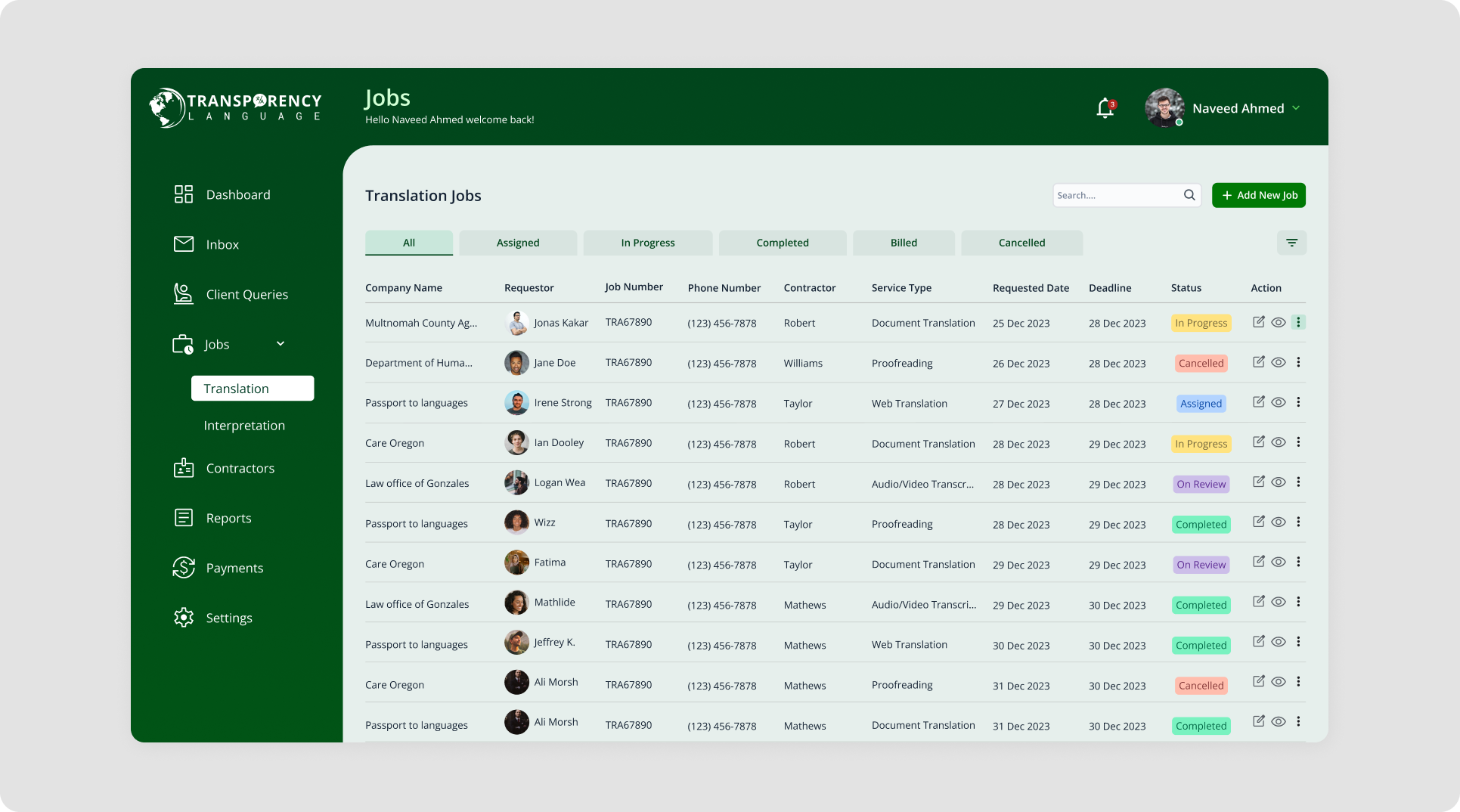
To bring the project to life, our UI designers created two visual concepts for the Dashboard. After careful review, the client selected Option 02, which provided a modern and intuitive interface that aligned with their vision. 

High-Fidelity Design in Figma

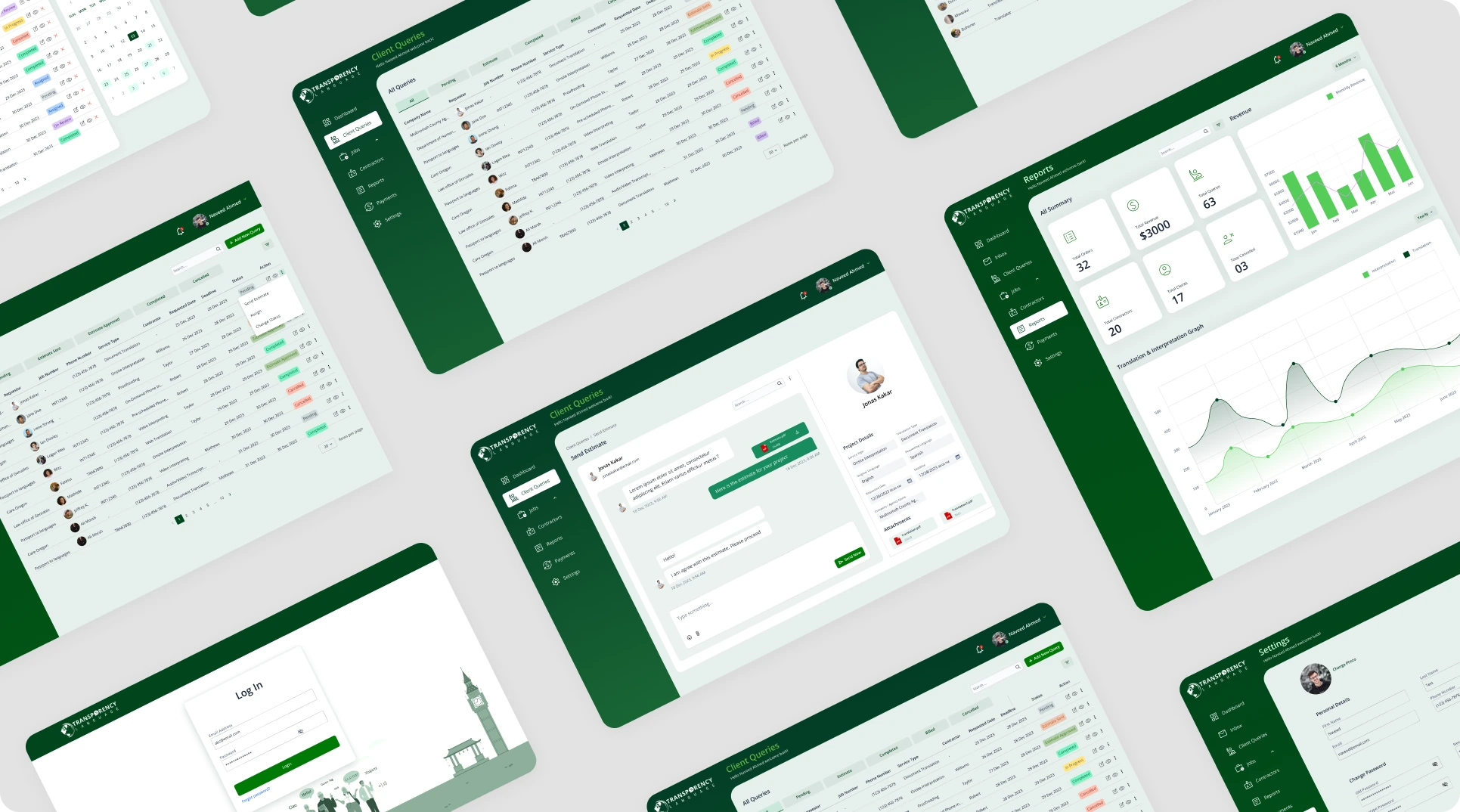
Once the dashboard concept was approved, we extended this visual direction across the entire software, creating high-fidelity designs in Figma. These detailed screens incorporated all user interactions and features needed for the CRM to function smoothly while keeping the design intuitive and user-friendly. 

Solutions We Provided

Centralized Customer Queries and Assignment Management

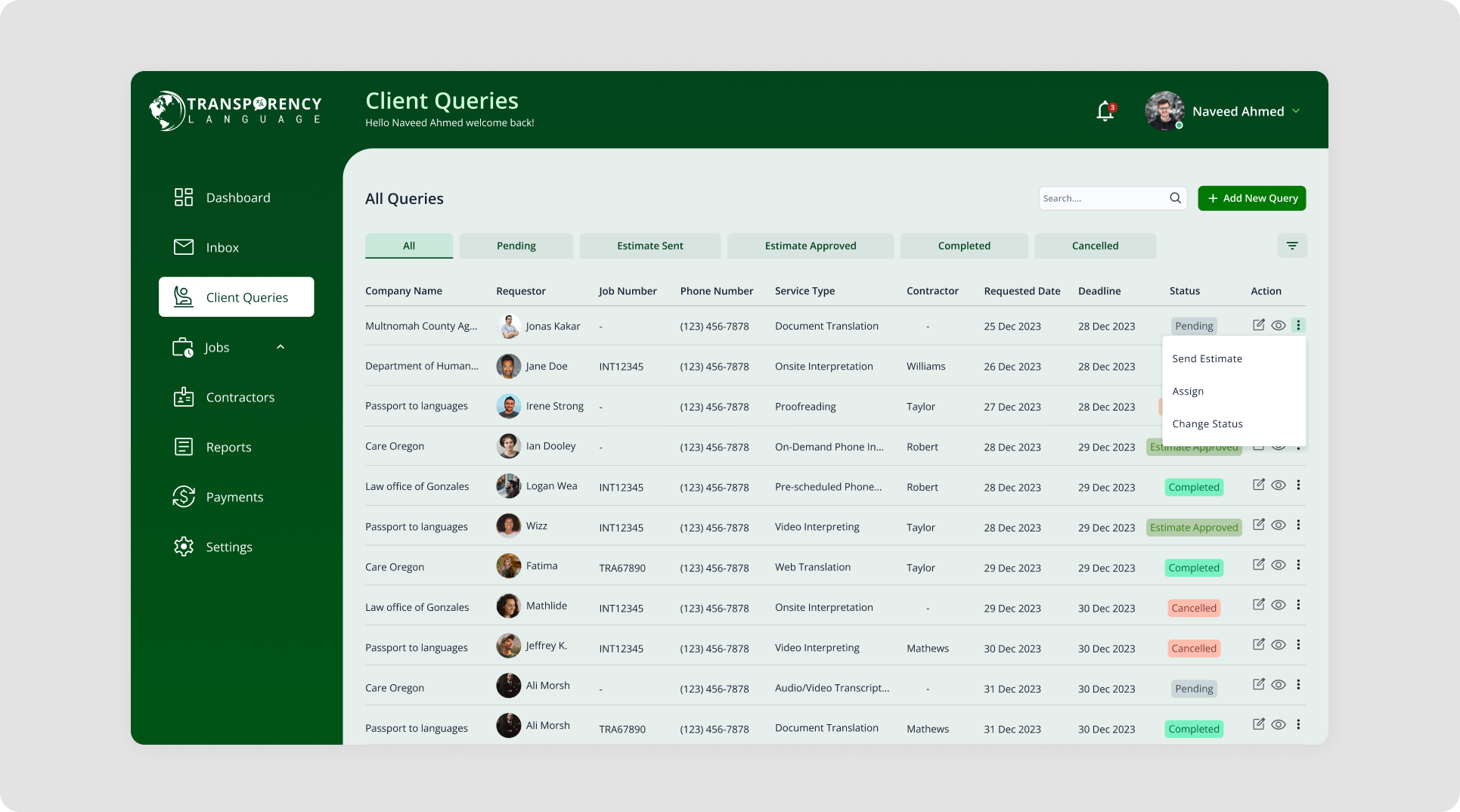
We developed a CRM that centralizes all customer queries, making it easy for admins to manage incoming requests. From this single platform, users can decide which queries to proceed with, send estimates, and assign jobs to the appropriate interpreters or translators—all in one place. 

Separation of Translation and Interpretation Jobs

To simplify job management, we created a clear division between translation jobs and interpretation jobs. This allows admins to manage each type of service independently, view job statuses, send assignment forms, and track job progress with ease. 

Integrated Inbox for Seamless Communication

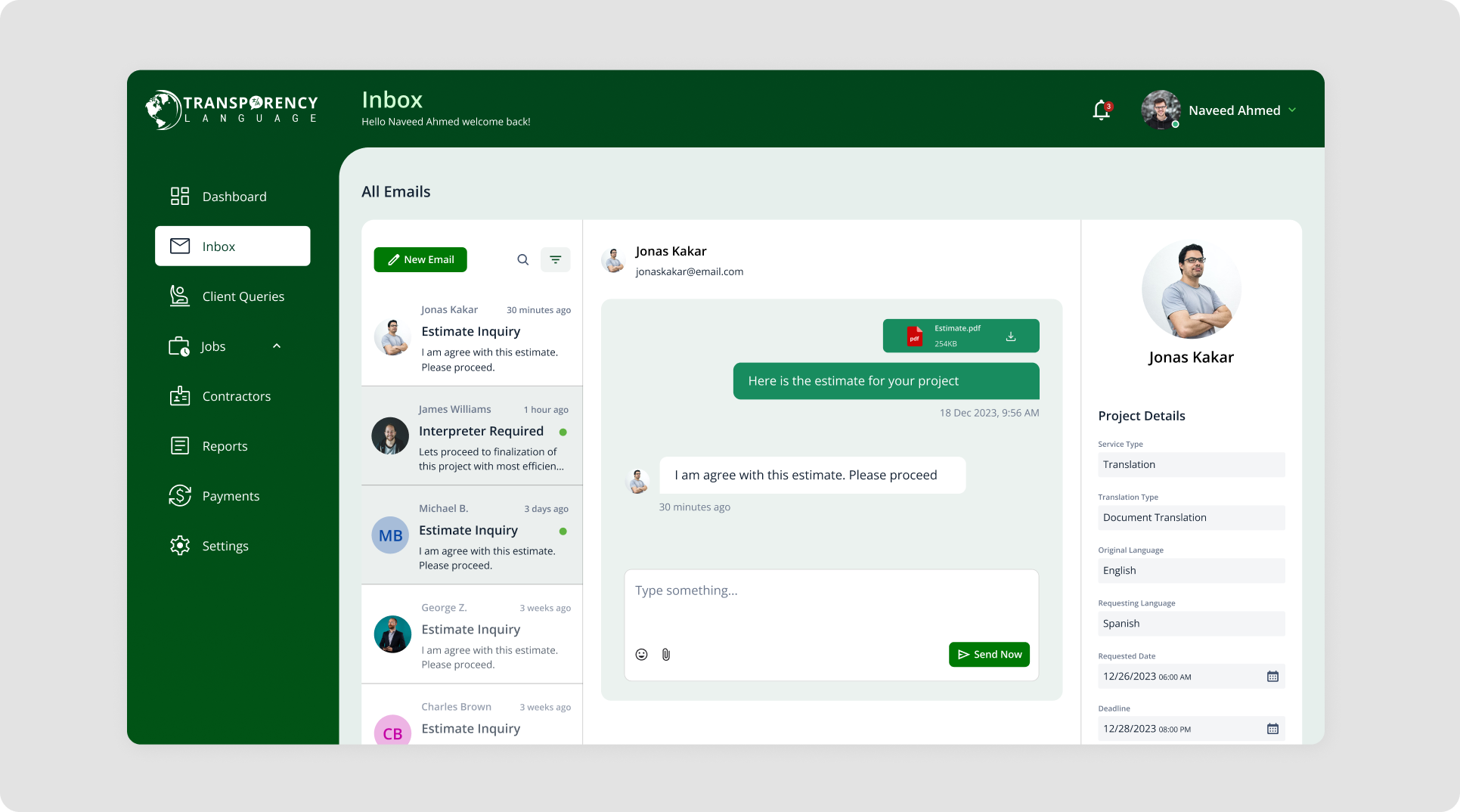
An integrated inbox feature was added to facilitate communication directly within the CRM. Admins can easily email clients or communicate with contractors (interpreters/translators), send and receive documents, and maintain a record of all conversations related to each job. 

Payment Management and Invoicing

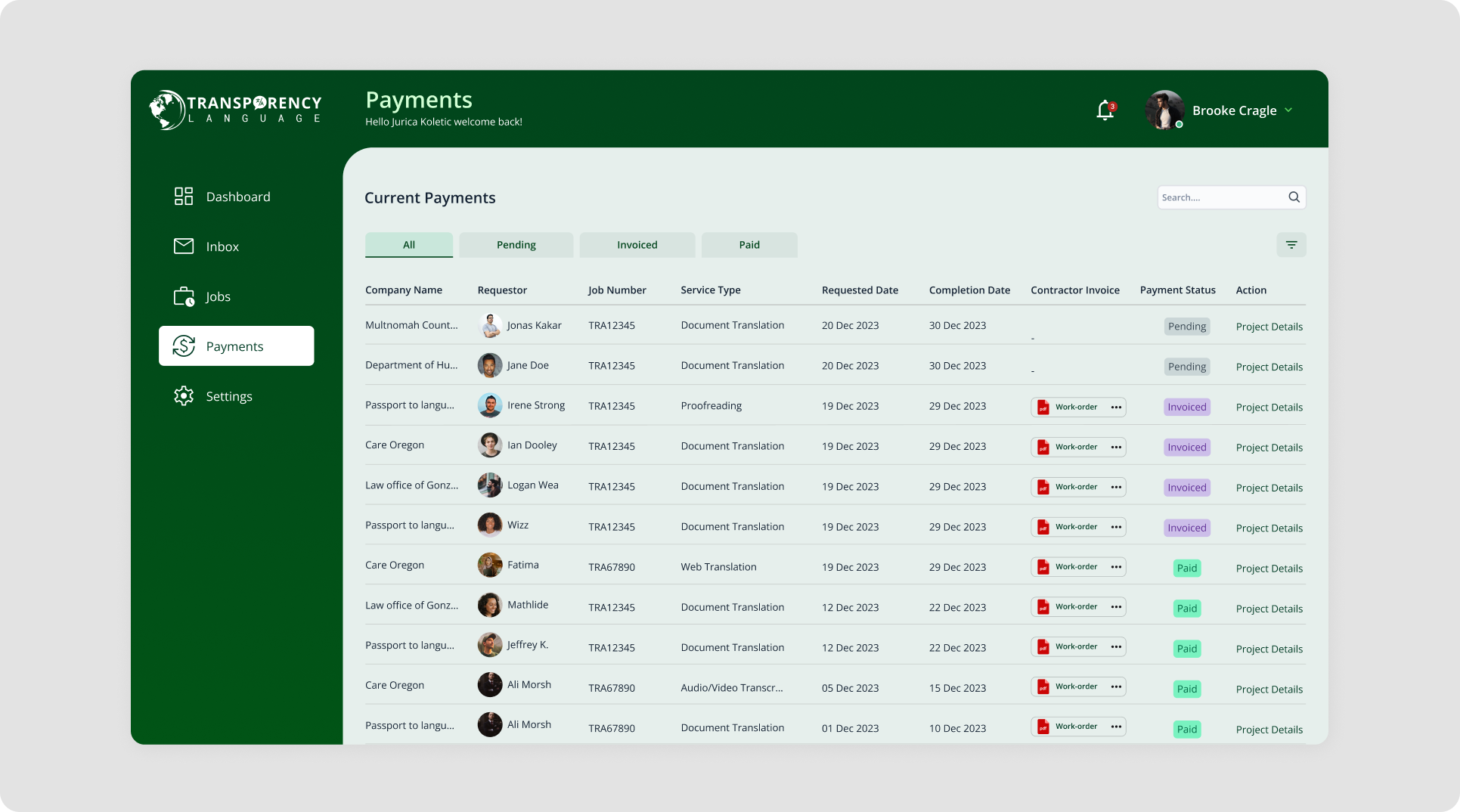
Our CRM also includes a payment management module. This allows users to track payments received from clients and manage payments sent to contractors. The system automatically updates payment statuses, making it easier for Transparency Language to stay on top of their financial transactions. 

Conclusion: Automating Transparency Language's Operations for Efficiency and Growth

At Qualix Solutions, we successfully transformed Transparency Language’s business by building a custom CRM tailored to their unique needs. By automating customer queries, job assignments, communication, and payments, we streamlined their operations and improved overall efficiency. Our design and development solutions allowed Transparency Language to shift from a manual, Microsoft Access-based process to a modern, automated CRM that supports the business as it grows. 

With a clean, user-friendly design and an organized workflow, Transparency Language is now better equipped to handle the increasing demands of their clients, while maintaining their high standards of service delivery. 

case studies

See More Case Studies

top features of supply chain management software

What Are the Top Features of Supply Chain Management Software?

  Managing a supply chain with spreadsheets and disconnected systems creates bottlenecks, delays, and costly errors. Whether you’re dealing with inventory shortages, supplier issues, or transportation headaches, the right software transforms these challenges into opportunities for efficiency and growth. This guide breaks down the essential features you need when evaluating supply chain management software tools, helping you choose a solution that actually solves your problems. Why Supply Chain Management Software Matter? The importance of supply chain management software goes beyond tracking inventory. Modern software operations eliminates visibility gaps, automates manual processes, ensures compliance, and enables proactive decision-making across your entire network. Supply chain management in the software industry has evolved into sophisticated platforms that connect suppliers, warehouses, carriers, and customers in real-time. These software tools reduce operational costs while improving delivery performance and customer satisfaction. Top Features of Supply Chain Management Software 1. Real-Time Inventory Control Supply chain inventory management software needs robust tracking across all locations. Your system should monitor stock levels in warehouses, stores, trucks, and ships simultaneously. Look for automated reordering that triggers purchases when stock runs low. The best systems adjust these triggers based on sales patterns and upcoming promotions. For regulated industries, serial number and lot tracking becomes mandatory. When quality issues arise, you can trace affected products instantly and execute targeted recalls. Cycle counting features maintain accuracy without shutting down operations. The software schedules regular counts for different sections, catching discrepancies before they balloon into major problems. 2. Demand Forecasting and Planning The capabilities of systems shine in demand prediction. Advanced algorithms analyze sales history, seasonal patterns, and market conditions to forecast future needs. Scenario planning lets you test different strategies before committing resources. Model what happens if a key supplier fails, demand spikes unexpectedly, or new competitors enter your market. Collaborative forecasting pulls insights from sales teams, major customers, and suppliers. This consensus approach beats pure statistical methods because it incorporates market intelligence that data alone misses. 3. Supplier Performance Management Software must track supplier reliability. Performance scorecards measure on-time delivery, defect rates, and responsiveness to issues. Risk assessment tools flag suppliers who pose threats to your operations—whether from financial instability, geographic concentration, or lack of backup options. Supplier portals streamline communication. Vendors access forecasts, submit quotes, and update shipment status directly in your system, cutting email chains and phone calls. 4. Procurement Automation Supply chain tools and techniques for procurement eliminate manual bottlenecks. Automated workflows route purchase requests through approval chains based on dollar amounts and budget availability. E-sourcing features manage RFQs and bids digitally. Compare proposals side-by-side and award contracts based on objective criteria rather than relationships or convenience. Spend analytics reveal purchasing patterns. You’ll spot opportunities to consolidate vendors, negotiate volume discounts, and stop unauthorized spending. 5. Transportation Planning and Execution Logistics management software features optimize how goods move. Multi-modal planning finds the best combination of trucks, trains, ships, and planes based on cost, speed, and reliability requirements. Carrier management tools compare rates, book shipments, and track performance across your transportation network. Freight audit capabilities catch billing errors and overcharges automatically. Load optimization fills vehicles efficiently by considering weight limits, volume constraints, and delivery sequences. Better utilization means fewer trips and lower costs. 6. Warehouse Integration While inventory management software handles strategic decisions, warehouse integration manages daily operations. Systems direct workers along optimal picking paths and suggest the best storage locations for incoming products. Wave planning batches orders intelligently for release to the warehouse floor. Labor tracking identifies productivity patterns and training opportunities. 7. Cloud-Based Architecture Cloud based supply chain software delivers flexibility that on-premise systems can’t match. Access your data from anywhere, scale up or down based on seasonal needs, and skip the hardware maintenance headaches. Automatic updates keep you current with new features and security patches. Implementation happens faster because there’s no infrastructure to build. 8. Analytics and Reporting SCM functionality requires strong analytical tools. Dashboards show different metrics for warehouse managers versus executives. Exception alerts notify you when performance falls outside acceptable ranges. Predictive analytics spot trends before they become problems. Historical analysis reveals long-term patterns that shape strategic planning. 9. Order Fulfillment Management Order promising gives customers accurate delivery dates based on current inventory and production capacity. Allocation logic prioritizes high-value orders and reserves inventory appropriately. Drop-ship and cross-dock support offers fulfillment flexibility. Modify in-flight orders when possible to accommodate customer changes. Returns management handles reverse logistics efficiently—from initial authorization through restocking and credit processing. 10. Global Trade Compliance For international operations, compliance features prevent costly mistakes. Automated documentation generates commercial invoices, certificates of origin, and export declarations correctly. Restricted party screening checks customers and suppliers against government denied-parties lists. Duty optimization analyzes different scenarios to minimize customs charges through smart classification and valuation. 11. Quality Control Integration Elements of supply chain management include quality assurance. Track non-conformances, document corrective actions, and measure supplier quality trends over time. Certificate of analysis management ensures raw materials and finished goods meet specifications before they move through your supply chain. 12. Financial Visibility Top supply chain management software companies integrate financial tracking throughout. ERP connections synchronize activities with accounting for accurate costing. Working capital optimization identifies ways to improve cash flow—whether through inventory reduction, extended payment terms, or faster collection cycles. 13. Collaboration Tools Modern tools and techniques emphasize connectivity. Supplier portals enable self-service access to forecasts and order status. Internal messaging keeps teams aligned without endless email threads. Document management centralizes specifications, drawings, and certificates. Workflow automation routes approvals to the right people based on business rules. 14. Mobile Access Supply chain monitoring software supports workers wherever they are. Warehouse staff use mobile apps to scan barcodes and confirm tasks. Managers approve requests from their phones. Executives check dashboards during meetings or while traveling. Offline capabilities let work continue in areas with poor connectivity, syncing data when connection returns. 15. Intelligent Automation Leading software product for SCM solutions incorporate automation that learns from patterns. Demand sensing detects shifts in buying behavior faster than traditional forecasting. Process optimization

Learn more
Contact us

Partner with Us for Comprehensive IT

We’re happy to answer any questions you may have and help you determine which of our services best fit your needs.

Your benefits:
What happens next?
1

We Schedule a call at your convenience 

2

We do a discovery & consulting meeting 

3

We prepare a proposal 

Schedule a Free Consultation