MarketPro – AI-Driven Social Media Management Software

CASE STUDY BY QUALIX SOLUTIONS

Introduction to the Product

Our client approached us with a vision to create a powerful social media management tool named “MarketPro.” The software’s key feature was its AI-driven content generation, allowing users to create and publish social media posts effortlessly across platforms like Facebook, Instagram, and LinkedIn. The client’s goal was to streamline the content creation process for users and offer a SaaS solution with three customizable plans to cater to different user needs. Initially, MarketPro focused on these three platforms, with the potential to expand to more social networks in the future.

The Problem

The client faced multiple challenges, which they brought to us at the outset:

  1. The client lacked in-depth technical knowledge of building such software and required a development partner to manage the complexities of design and development.
  2. The client wanted to minimize their involvement, desiring a fully functional MVP with only essential input from their side.

Initial Requirements

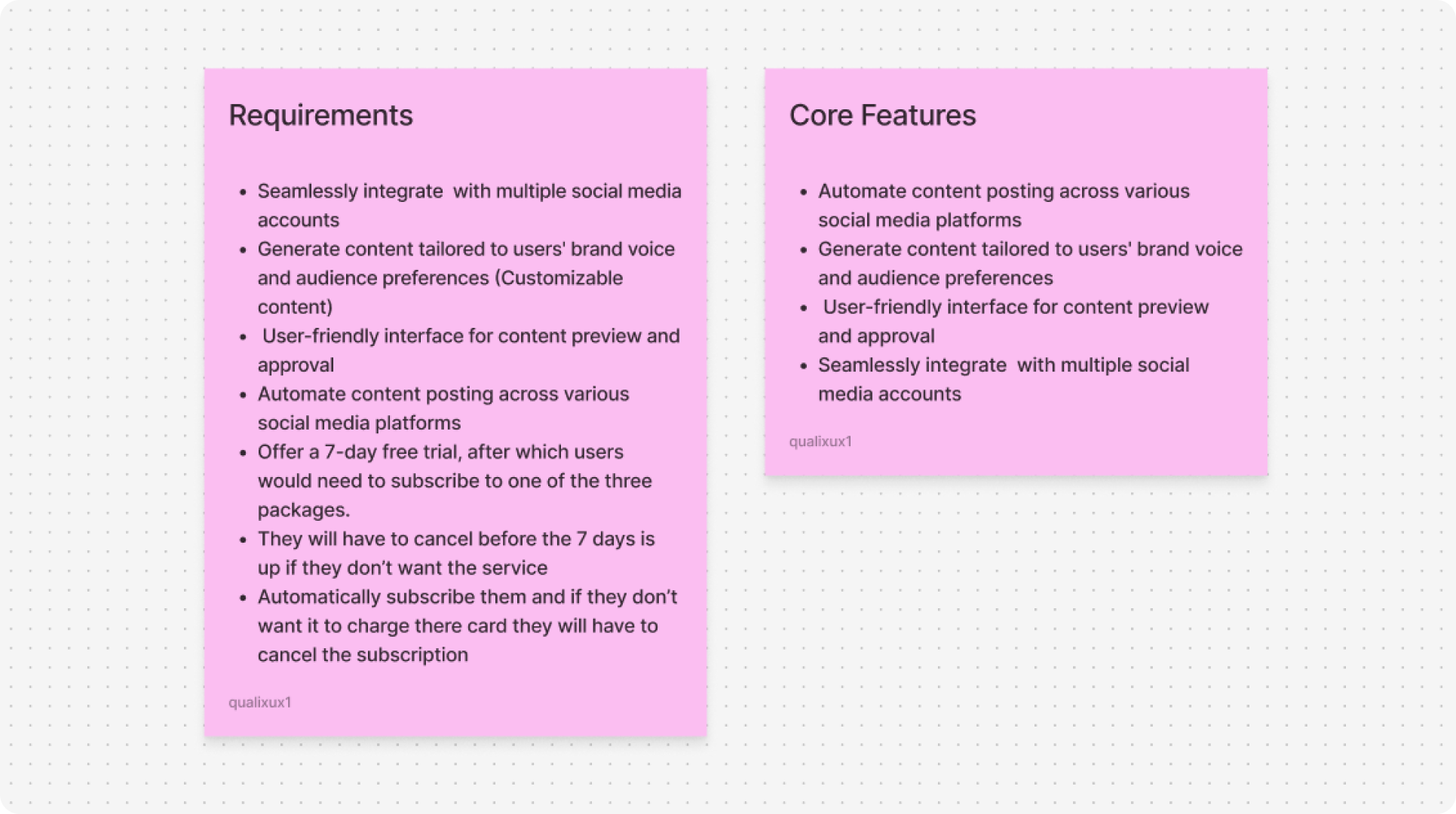
When we began collecting requirements, the key features the client outlined included:

  1. Seamless integration with multiple social media platforms
  2. AI-generated content customized for users’ brand voice and audience
  3. A user-friendly interface to preview content before publishing
  4. Automation of social media posting across various accounts
  5. A 7-day free trial for new users, with auto-subscription to one of the three plans unless canceled before the trial ends

Competitive Research

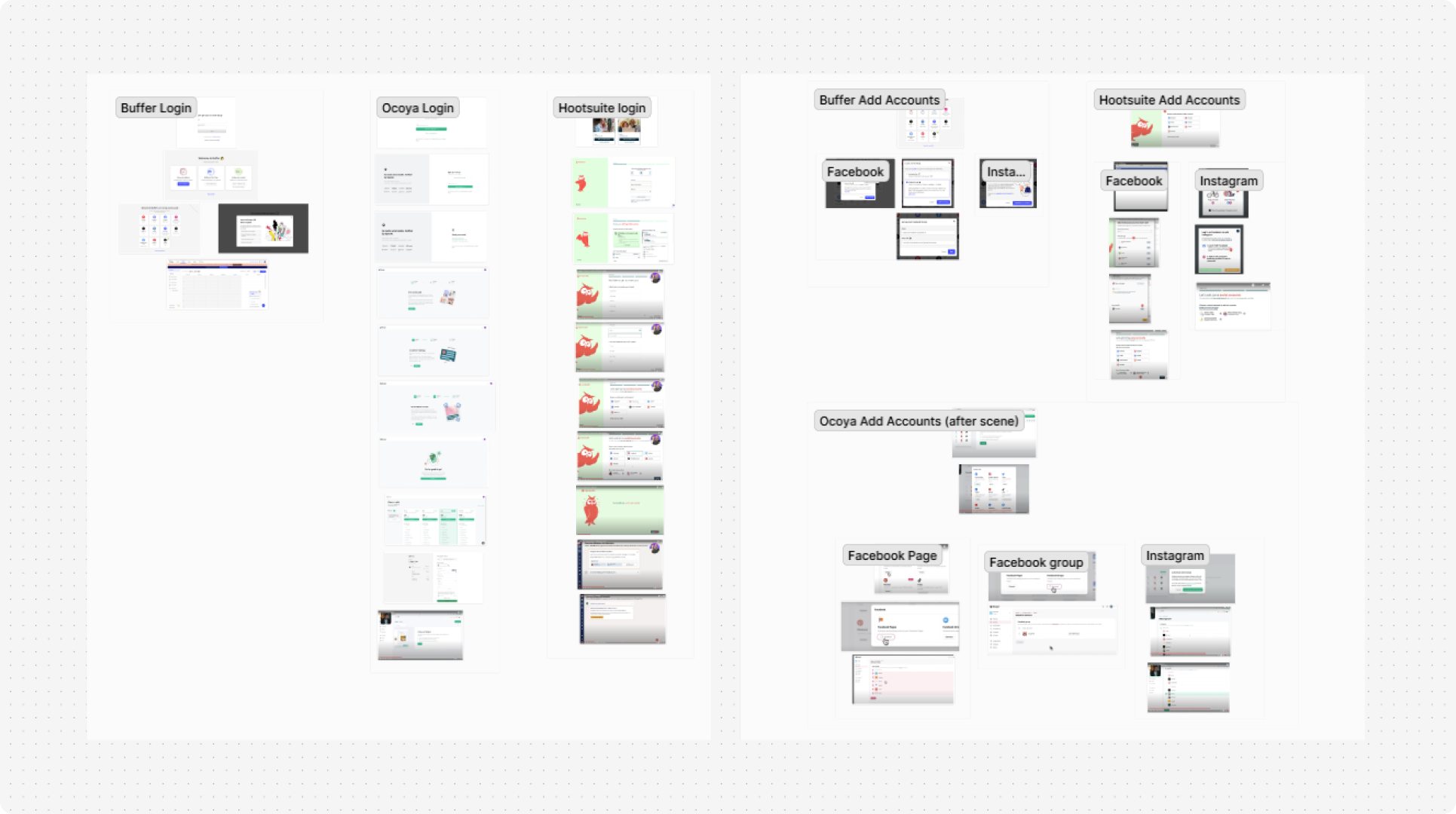
To deliver the best solution, we conducted extensive research on the competitive landscape. We identified three major competitors in the space:

  1. Hootsuite
  2. Buffer
  3. Ocoya

Our research helped us understand their strengths and weaknesses, which informed the direction of MarketPro’s development.

Challenges We Discovered

During our competitive research, we identified several key challenges:

Challenge 01:

Competitors offered highly polished UI/UX, attracting new users easily.

Challenge 02:

Their content creation modules were overly complex, making it difficult for non-technical users.

Challenge 03:

Most competitors focused solely on text-based AI content generation, limiting users’ creative freedom.

Challenge 04:

Competitors’ overall user experience was not beginner-friendly, often requiring steep learning curves.

Challenge 05:

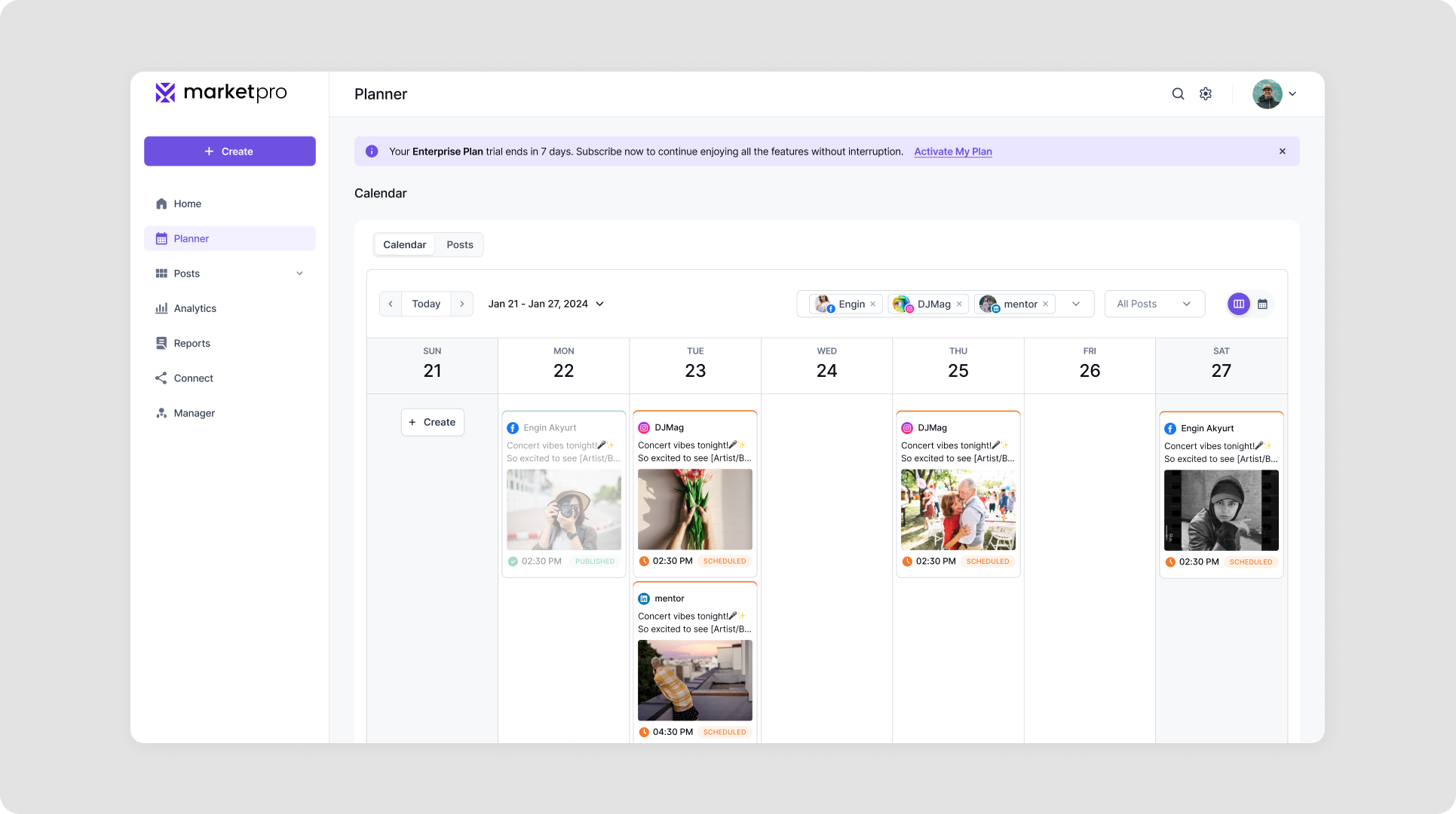
Competitors lacked an intuitive way to display scheduled and published posts at a glance.

Challenge 06:

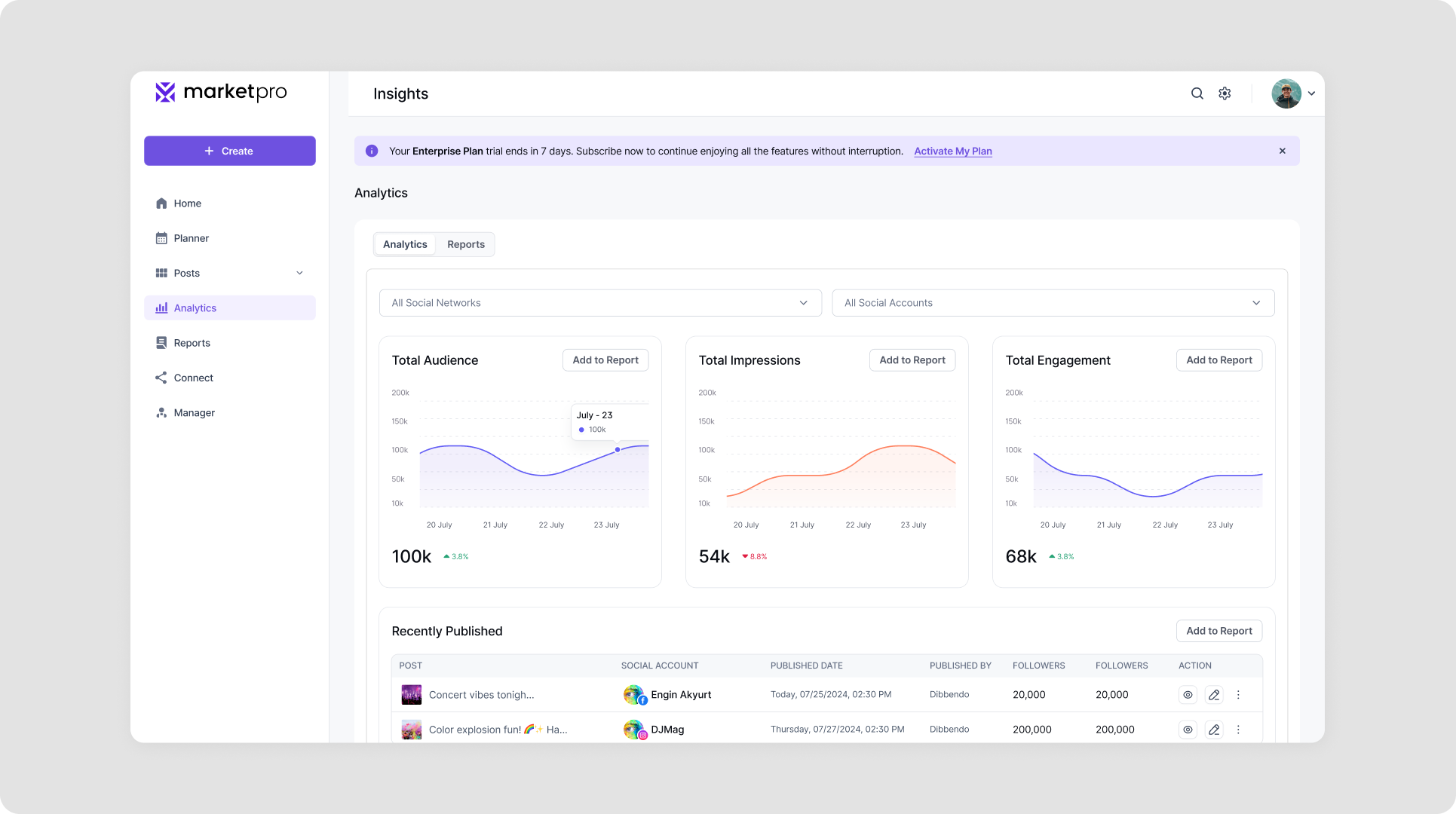
Competitors didn’t offer flexible, easy-to-understand analytics or customizable reports for users managing multiple accounts.

Creating the User Flow

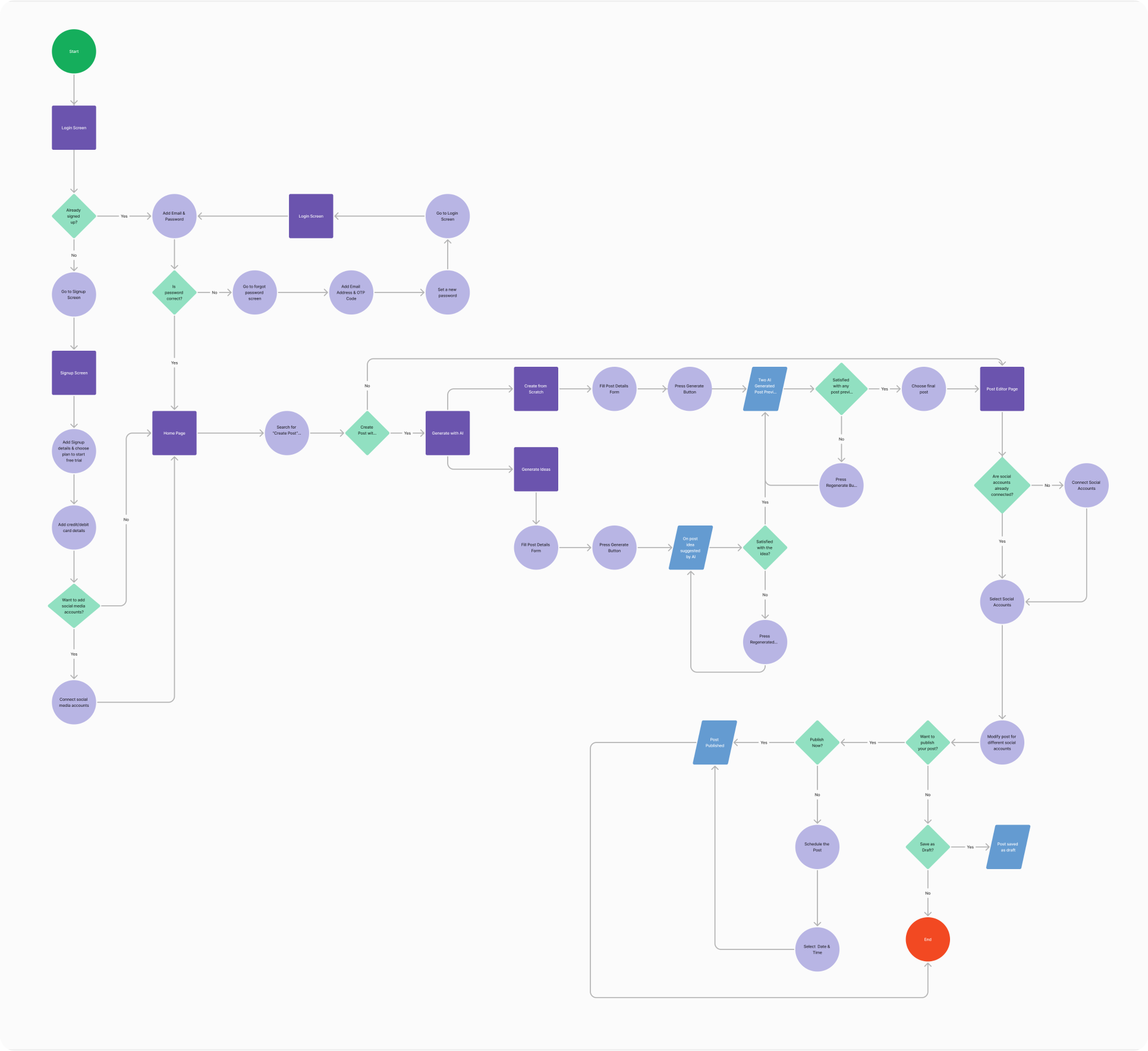
We created a general user flow that defined the user’s journey to achieve the basic goal of content generation. This flow covered everything from onboarding to creating and publishing posts, ensuring a smooth experience for the end user.

Wireframe Creation

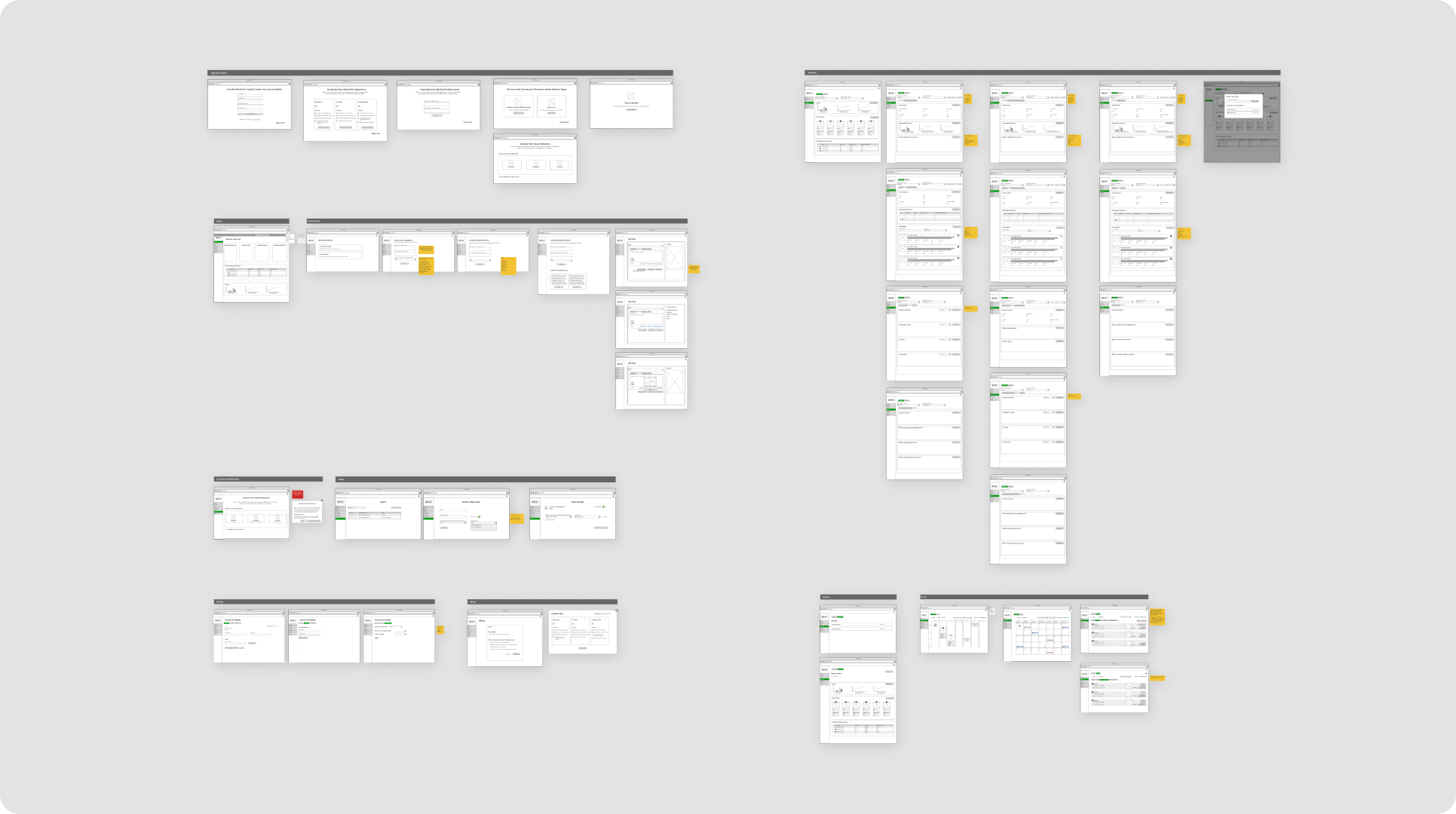
After conducting competitive research, our User Experience designers crafted mid-fidelity wireframes, mapping out every screen and option. This process provided clarity to both the client and our team, ensuring all elements were accounted for. We shared the wireframes with the client and incorporated their feedback before moving forward.

First Look and Feel of the Software

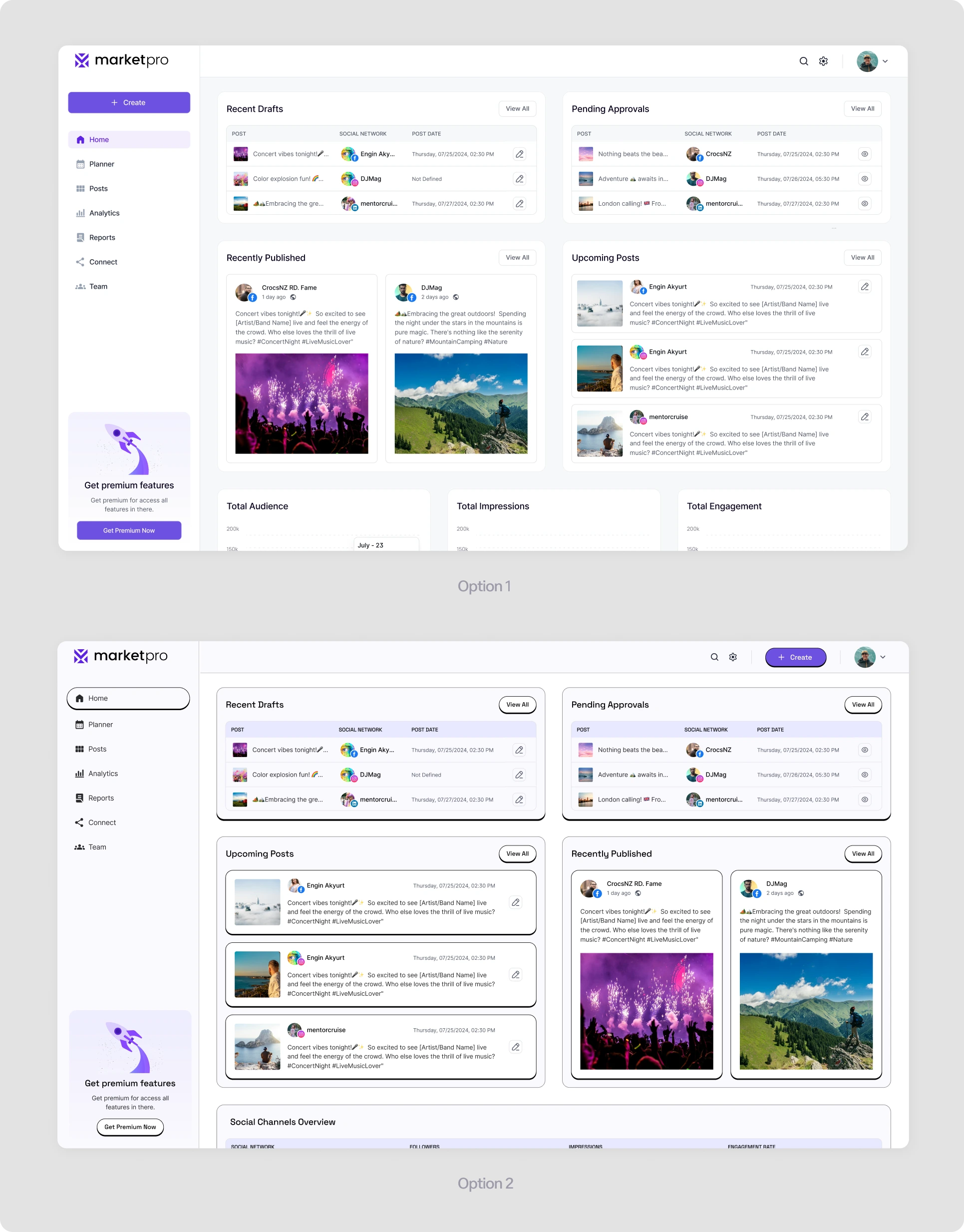
Once the wireframes were approved, our UI designers focused on creating moodboards and performing visual research. We designed two variations of the MarketPro Home Screen, allowing the client to choose their preferred style. The client selected Option 01 as the visual direction for the project.

Complete High-Fidelity Design Creation in Figma

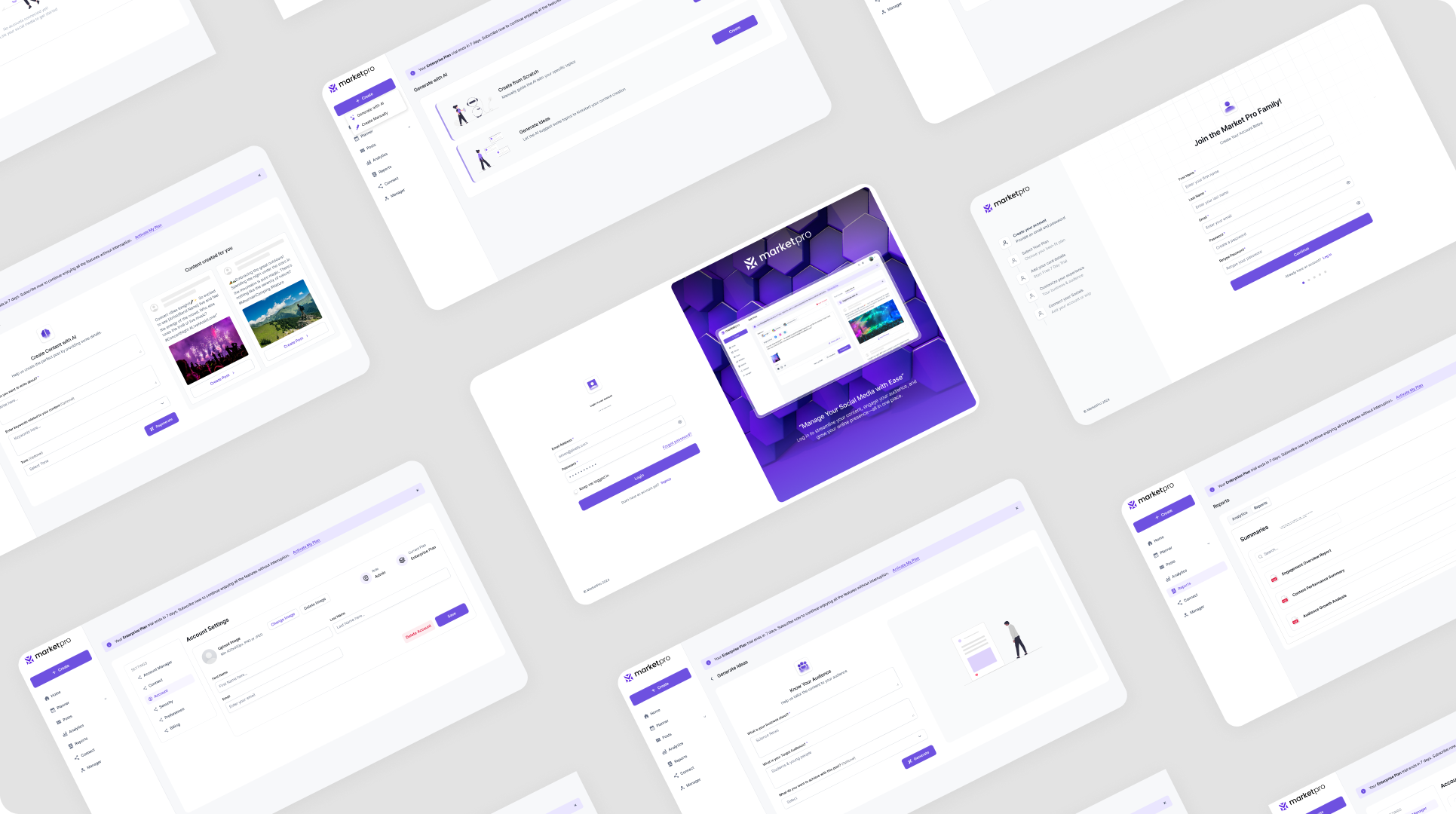
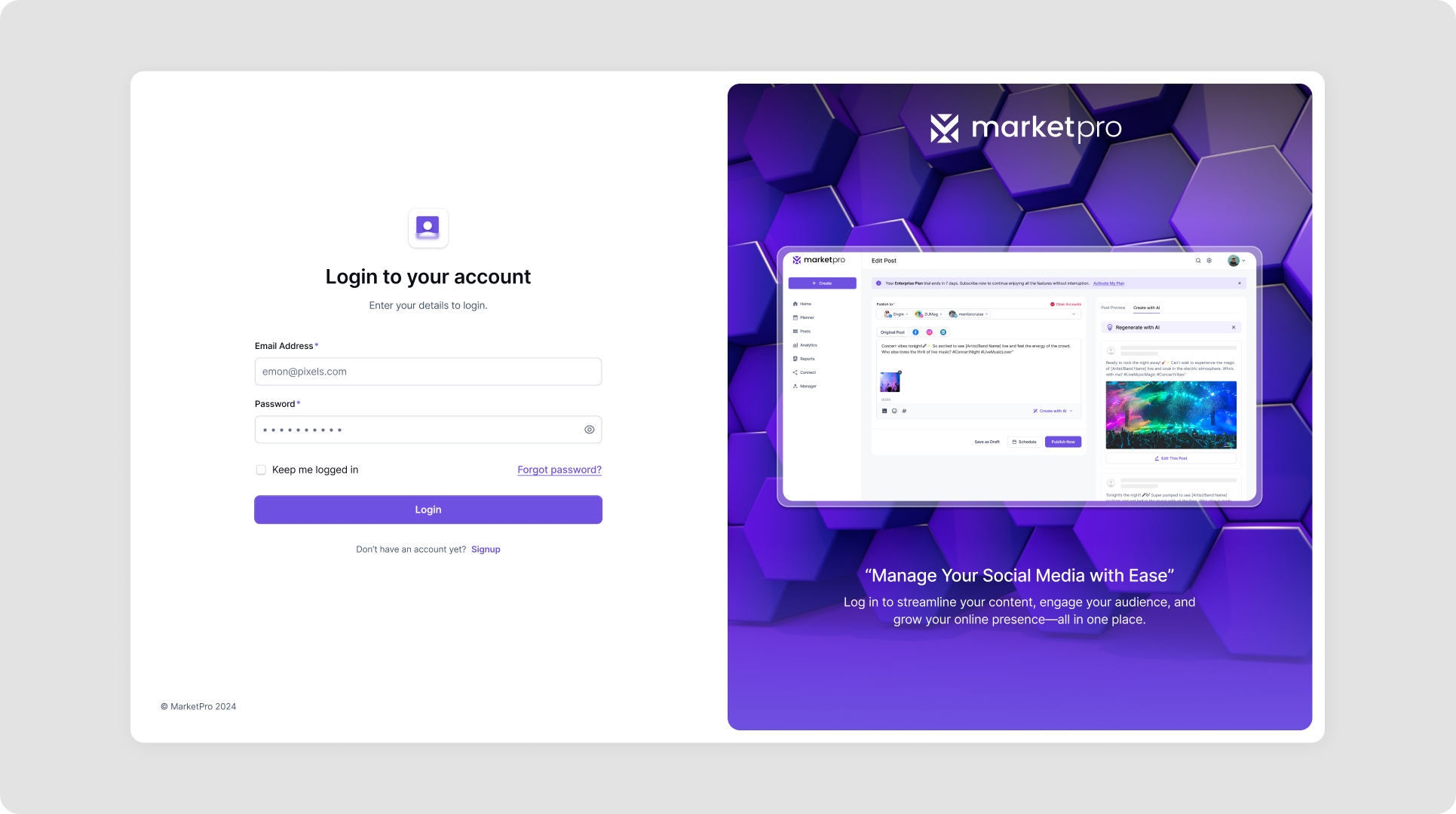
After receiving approval on the first screen design, we continued with the chosen visual style and completed the entire software design in high fidelity using Figma. We used the wireframes as our guide and ensured every element maintained consistency and alignment with the client’s vision.

The Solution

Creating an Engaging UI/UX to Solve Challenge 01

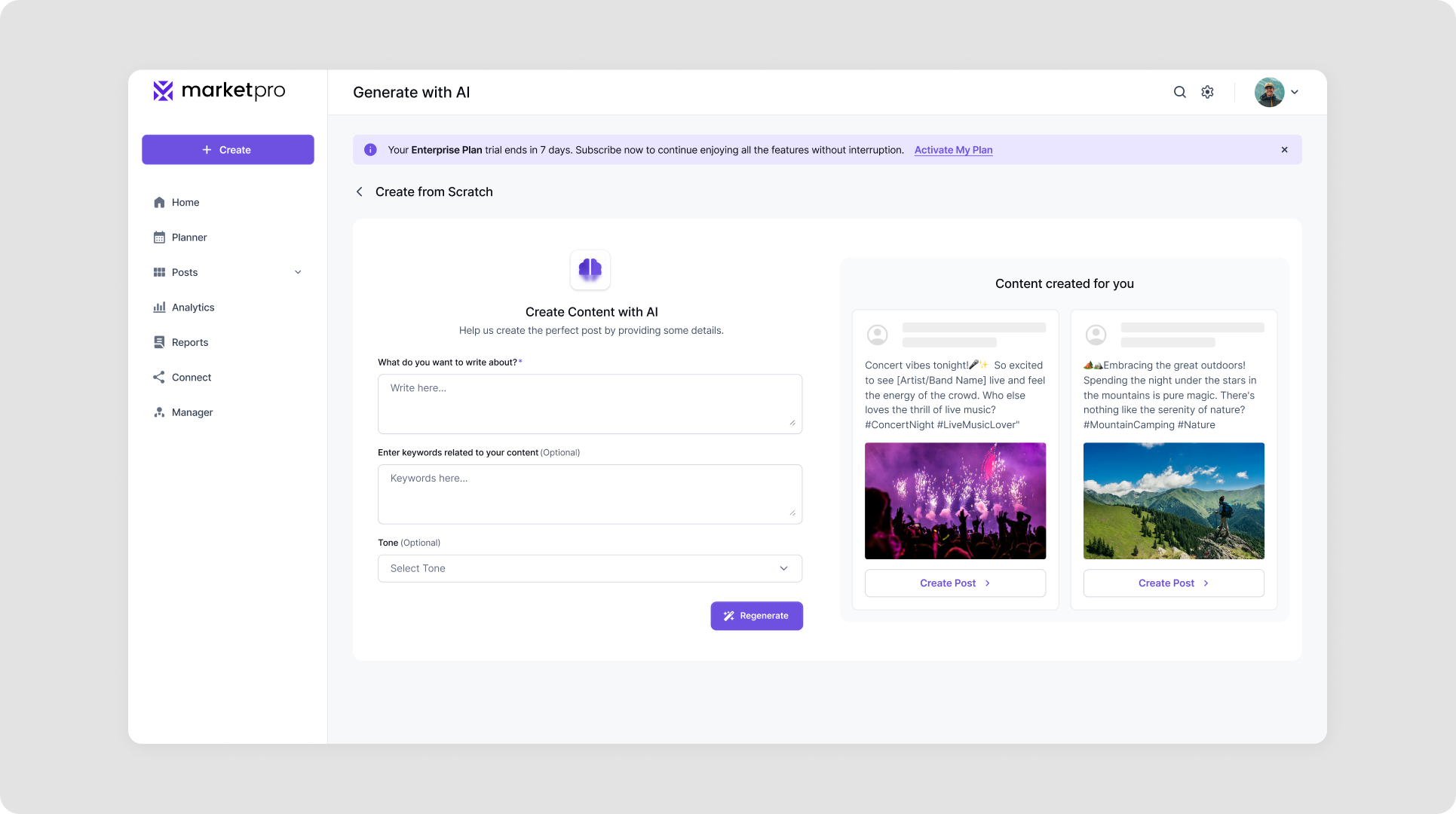
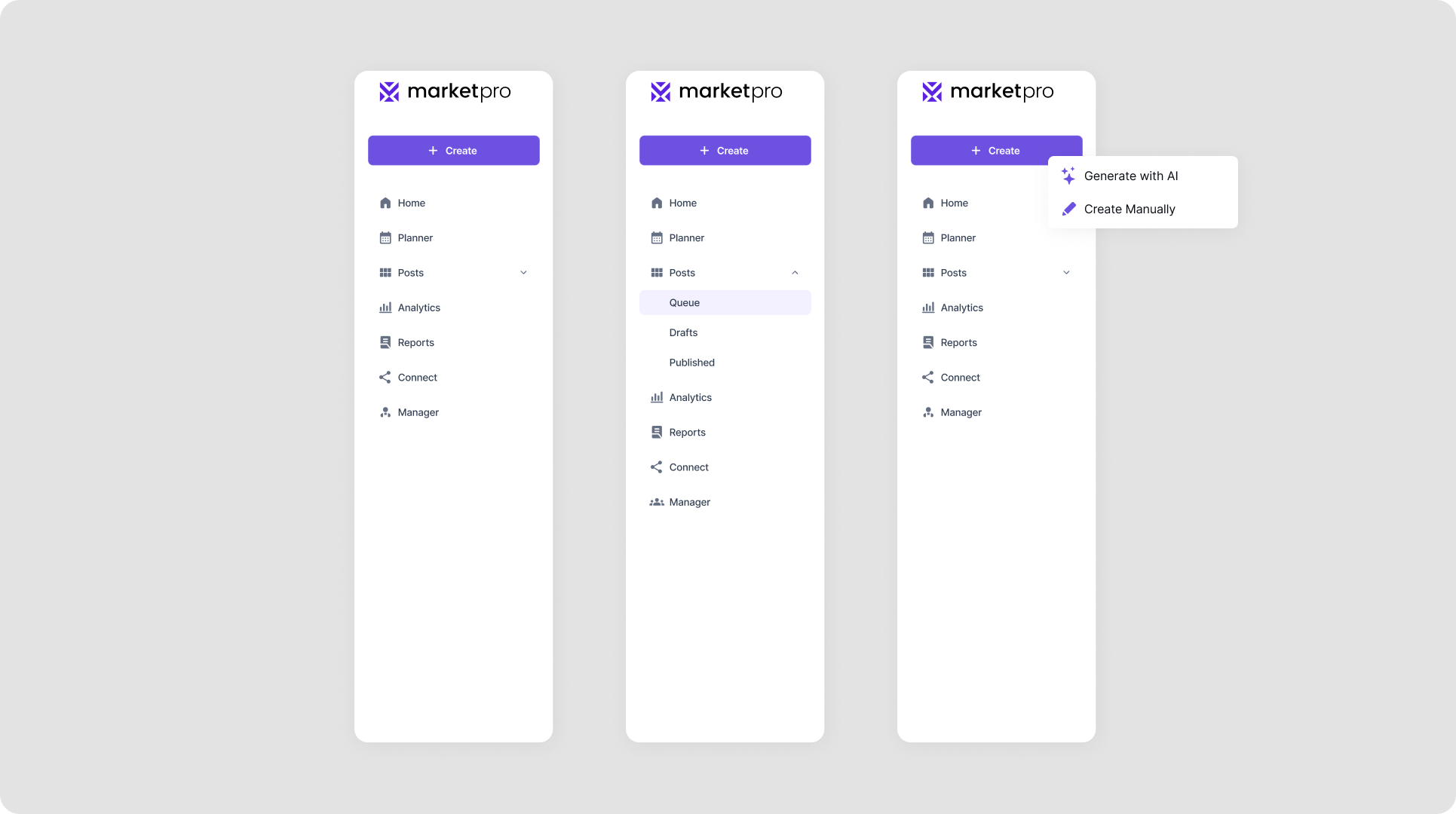
To address the challenge of competitors offering a polished UI/UX, we designed an eye-catching and intuitive interface for MarketPro. Our main focus was on creating a seamless user experience, ensuring that users would not only find it easy to use but would also enjoy interacting with the platform.

Simplifying Content Creation to Solve Challenge 02

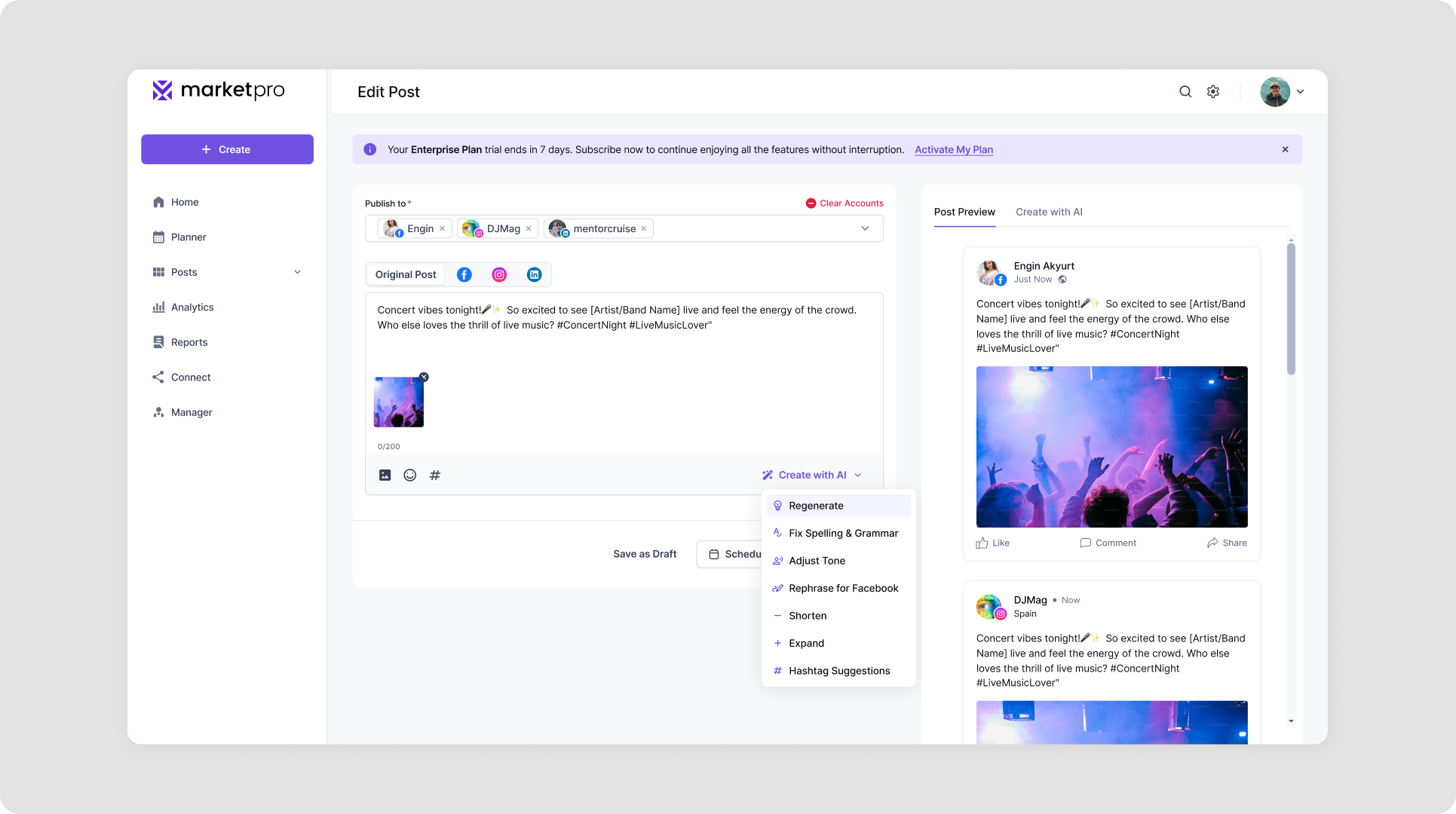
We built a user-friendly content generation editor that houses all the necessary tools for content creators. From AI-powered hashtag generation to spelling and grammar correction, users can craft posts effortlessly. Features like tone adjustment allow users to match their brand voice with minimal effort.

Expanding Beyond Text-Based Content to Solve Challenge 03

We expanded MarketPro’s capabilities beyond text-based content creation by incorporating AI-driven visual content generation. This provided users with a complete solution for both text and visuals, eliminating the need to search for external images or graphics.

Making the Software Beginner-Friendly to Solve Challenge 04

MarketPro’s UI/UX is specifically designed to be beginner-friendly, unlike the more complex interfaces of our competitors. Users can quickly navigate through options, find necessary features with ease, and create content with just a few clicks. The simple layout ensures a seamless experience for first-time users and professionals alike.

A Calendar View for Posts to Solve Challenge 05

We implemented a monthly and weekly calendar view, allowing users to easily track both scheduled and published posts. This feature helps users to spot any gaps in their posting strategy and adjust accordingly, ensuring a consistent content pipeline.

Advanced Analytics & Reporting to Solve Challenge 06

MarketPro offers in-depth analytics, with detailed insights into social media performance across accounts. Users can generate combined or individual reports, export them as PDFs, and share them with collaborators. This allows businesses to refine their strategies and focus on areas that need improvement.

Conclusion

At Qualix Solutions, we transformed our client’s vision into a fully functional SaaS product with MarketPro. Through extensive research, wireframing, and design, we tackled the challenges of user experience, content creation, and analytics. By creating a product that is intuitive, visually engaging, and feature-rich, we exceeded client expectations and delivered a complete social media management solution.

MarketPro not only simplifies social media management but also empowers businesses to create, schedule, and analyze their social media content with minimal effort. With MarketPro, users can focus on growing their brand while our platform handles the complexities behind the scenes.

case studies

See More Case Studies

how to automate instagram posts with ai

How to Automate Instagram Posts with AI

If you’re still posting manually on Instagram, you’re already behind. Teams today are using AI to generate captions, create visuals, schedule posts, respond to DMs, and even optimize posting times. More consistent content, faster execution, and better engagement without burning out your team. This guide breaks down how to automate Instagram posts with AI, step by step, using real workflows, tools, and strategies that actually work. Why Businesses Are Automating Instagram with AI Let’s start with reality. Most teams struggle with: Inconsistent posting Content fatigue Manual scheduling Delayed responses Lack of performance insights   AI solves these problems by turning Instagram into a system instead of a task. What changes when you automate: Content is created faster Posts go out consistently Engagement improves due to timing Teams stop doing repetitive work   Can You Automate Instagram Posts?   Yes, but with limitations. Instagram allows automation through: Meta Graph API (official way) Approved scheduling tools Automation platforms like n8n, Make, Zapier However: Full bot-like automation (spam posting, fake engagement) is restricted You must follow Instagram API rules The goal is smart automation, not risky shortcuts How to Automate Instagram Posts with AI (Step-by-Step)   Here’s the exact framework used by automation consultants. Step 1: Define Your Content Inputs   Before AI can automate anything, it needs inputs. These can be: Google Sheets (content calendar) Airtable (content pipeline) Notion (content ideas) Google Drive (media assets)   Example structure: Post title Caption idea Image/video Hashtags Publish date   Step 2: Use AI to Generate Content   This is where AI changes everything. You can automate: Captions Hashtags Hooks CTAs   Example workflow: Input topic → “5 AI tools for marketers” AI generates: Caption Hashtags Emoji formatting   Step 3: Create AI Visuals or Videos   AI is now heavily used for content creation. For images: AI-generated graphics Templates with automation Canva + AI tools   For videos: AI reels Voiceovers Auto subtitles   Step 4: Connect Automation Workflow   Now comes the core system. Use tools like: n8n Make.com Zapier   Example workflow: New row added in Google Sheet AI generates caption Image pulled from Drive Post scheduled via Instagram API   Step 5: Schedule & Publish Automatically   Automation tools connect to Instagram via: Meta Graph API Scheduling integrations You can: Schedule posts Auto-publish Queue content   Step 6: Add Smart Enhancements   To improve results: AI chooses best posting time Auto-generate hashtags Track engagement Adjust content strategy   How to Automate Instagram Posts with AI Free   Yes. You can do this without spending much. Free stack example: Google Sheets → content planning OpenAI (free credits / low cost) → captions Canva free → visuals n8n self-hosted → automation   How to Automate Social Media Posts with AI (Beyond Instagram)   Once you build one system, you can expand it. Same workflow can: Post on LinkedIn Publish on Twitter (X) Share on Facebook Send to email campaigns   AI becomes your content engine across channels How to Automate IG Posts Using n8n   n8n is one of the most flexible tools for automation. Basic workflow: Trigger → New content in database AI Node → Generate caption HTTP Node → Send to Instagram API Schedule → Time-based posting Why n8n works well: Open-source Custom workflows No vendor lock-in   Automate Instagram Posts Python (Advanced Setup)   For technical teams, Python gives more control. Example approach: Use Instagram Graph API Use Python scripts for: Uploading media Publishing posts Scheduling   Combined with AI: Python calls OpenAI API Generates caption Posts automatically   How to Create AI Chatbot for Your Instagram Using ChatGPT   Automation is not just about posting. You can automate conversations too. Example setup: User sends DM ChatGPT processes message Responds automatically Escalates if needed   Use cases: Lead qualification FAQs Appointment booking Product inquiries   Real-World Workflow Example (End-to-End)   Here’s what a real automation system looks like: Input: Content idea added in Airtable Process: AI generates caption AI suggests hashtags AI creates visual Automation: Scheduled via workflow Posted to Instagram After Posting: AI tracks engagement Suggests improvements   Common Mistakes to Avoid   Even good teams fail here. 1. Over-automation Not everything should be automated. 2. Ignoring content quality AI helps but strategy matters more. 3. No review layer Always include human approval for sensitive content. 4. API misuse Avoid violating Instagram policies. Benefits of Automating Instagram with AI   1. Consistency No missed posts. 2. Speed Content created in minutes. 3. Cost savings Less manual effort. 4. Better engagement Right content, right time. Human-in-the-Loop   Best systems are not fully automated. They include: AI generation Human approval Automated publishing This reduces: Errors Brand risk Compliance issues   Advanced Use Cases   1. AI Influencer Accounts Fully AI-generated profiles. 2. E-commerce Automation Product → caption → post → DM automation   3. Lead Generation Funnels Content → DM → chatbot → CRM   How AI Changes Instagram Strategy   Before AI: Manual posting Random ideas Delayed execution   After AI: Data-driven content Automated pipeline Faster growth cycles   Tools You Can Use   AI Tools: ChatGPT Claude Jasper   Automation Tools: n8n Make Zapier   Content Tools: Canva Midjourney Runway   Future of Instagram Automation   What’s coming next: Fully AI-generated brands Voice-to-content workflows Real-time personalization AI-driven engagement strategies   Final Thoughts – How to Automate Instagram Posts with AI Free   If you want to grow on Instagram today, manual posting is not enough. You need: AI for content Automation for execution Systems for consistency That’s how modern teams scale. FAQs – How to Automate Social Media Posts with AI   How to automate instagram posts with ai? You can automate Instagram posts with AI by generating captions, visuals, and hashtags using AI tools, then connecting them to automation platforms like n8n or Make to schedule and publish posts automatically via the Instagram API. How to automate IG posts for free? You can automate IG posts for free using tools like Google Sheets, n8n (self-hosted), and free

Learn more
how to get into ai automation

How to Get Into AI Automation – 2026 Guide for Startups, SMEs & Enterprises

AI automation is no longer a future concept, its a core driver of efficiency, growth, and competitive advantage across industries. If you’re wondering how to get into AI automation, this guide gives you a clear, practical roadmap tailored for startups, SMEs, and enterprise teams. Whether you’re exploring how to get started in AI automation, researching real-world insights like how to get into AI automation Reddit discussions, or evaluating how to invest in AI automation, this guide focuses on execution. Why Businesses Are Investing in AI Automation For startups, SMEs, and enterprises, AI automation is about doing more with less—without compromising speed or accuracy. Key Benefits 1. Operational EfficiencyAutomate repetitive tasks and free up teams for higher-value work. 2. Cost ReductionReduce dependency on manual labor and minimize operational overhead. 3. Faster ExecutionTasks that take hours or days can be completed in seconds. 4. Better Decision-MakingReal-time data and AI insights improve business decisions. 5. ScalabilityGrow operations without proportionally increasing headcount. How to Get Into AI Automation (Step-by-Step) Step 1: Identify High-Impact Use Cases Start by finding processes that are: Repetitive Time-consuming Rule-based Prone to human error Examples: Lead routing and qualification Customer onboarding workflows Data syncing between tools Report generation Email and notification automation Start small. One well-executed workflow delivers more value than ten incomplete ones. Step 2: Understand the Core Components To understand how to get started in AI automation, you need to know the building blocks: 1. Automation Platforms n8n (flexible, open-source) Zapier (easy to use) Make (visual builder) 2. AI Capabilities Text processing (AI models like GPT) Data extraction and classification Predictive logic 3. Integrations CRM systems Marketing tools Databases Communication platforms Automation becomes powerful when systems are connected. Step 3: Build Your First Workflow Start with a simple use case. Example Workflow: Lead Capture Automation Lead submits a form Data is enriched using AI Lead is scored based on rules Assigned to the right team Follow-up email is triggered This single workflow can improve response time and conversion rates significantly. Step 4: Choose Between DIY or Partnering Option A: Build Internally Best if: You have technical resources You want full control You can manage integrations Option B: Work With Experts Best if: You want faster results You lack internal expertise You need scalable systems For many businesses, working with experienced teams reduces risk and speeds up implementation. Step 5: Define Success Metrics Early AI automation must deliver measurable outcomes. Track: Time saved per task Cost reduction Error rate improvements Conversion or productivity gains Without clear metrics, automation becomes difficult to justify or scale. How to Get Started in AI Automation Without Technical Skills You don’t need to be a developer to begin. Practical Approaches 1. Use No-Code ToolsPlatforms like n8n and Zapier allow visual workflow building. 2. Start With TemplatesPre-built automations help you move faster. 3. Learn by DoingFocus on solving real business problems. 4. Explore Community InsightsIf you look at how to get into AI automation Reddit discussions, most users emphasize starting small and iterating. What Is AI Automation? AI automation combines artificial intelligence with workflow automation to eliminate repetitive tasks, improve decision-making, and streamline operations. Instead of relying on manual processes, businesses use AI automation to: Process data automatically Trigger workflows across systems Make decisions based on logic and patterns Reduce human intervention in routine tasks It applies across functions like marketing, sales, operations, customer support, and finance. Real-World Impact of AI Automation Before Automation: Manual processes across teams Delayed responses Data silos High error rates After Automation: Instant workflows Real-time data syncing Fewer errors Improved customer experience This shift directly impacts growth, efficiency, and customer satisfaction. Common Mistakes to Avoid 1. Trying to Automate Everything at Once Start focused and expand gradually. 2. Ignoring Data Quality Automation depends on clean, structured data. 3. Lack of Team Adoption Train your team to work alongside automation. 4. Tool-First Approach Start with the problem, not the tool. How to Invest in AI Automation If you’re thinking about how to invest in AI automation, focus on long-term value. Key Investment Areas 1. Technology Automation platforms AI tools Integration systems 2. Talent Automation specialists Process analysts 3. Process Optimization Automation works best when workflows are clearly defined and optimized first. ROI Framework Area Impact Priority Workflow Automation High Immediate System Integration High Short-term AI Decision Logic Medium Mid-term Full Automation Scaling Very High Strategic AI Automation Roadmap for Businesses Phase 1: Foundation (0–3 Months) Identify use cases Select tools Launch first workflow Phase 2: Expansion (3–6 Months) Automate multiple processes Connect systems Improve data flow Phase 3: Optimization (6–12 Months) Add AI-driven insights Enhance automation logic Scale across departments Where Most Companies Get Stuck Common challenges include: Lack of clear ownership Poor integration strategy Overcomplicated workflows Execution matters more than tools. Simplicity wins. Final Thoughts If you want to learn how to get into AI automation, the approach is simple: Start with one high-impact workflow Use no-code tools to move quickly Measure results from day one Expand based on success AI automation is not about replacing people—it’s about enabling teams to work faster, smarter, and more efficiently. For startups, SMEs, and enterprises, the opportunity is clear: those who adopt early gain a measurable advantage in speed, cost, and execution. FAQs How to get into AI automation as a beginner? Start with no-code tools, pick one workflow, and learn by building real use cases instead of focusing only on theory. How to get started in AI automation for business? Identify repetitive processes, choose a platform, and implement a simple workflow with measurable ROI. How to get into AI automation Reddit insights—what works? Most users recommend starting small, using templates, and improving workflows over time based on real needs. How to invest in AI automation if you are running startup agency? Invest in tools, talent, and process design to ensure long-term value and scalability. Is AI automation suitable for small businesses in the USA? Yes. Even small businesses can automate key processes to save time, reduce costs, and improve efficiency. Relevant

Learn more
how top consultancies use ai and automation

How Top Consultancies Use AI and Automation

The way consulting firms operate is changing fast. If you look at how top consultancies use AI and automation today, the shift is not just about technology, it’s about speed, decision-making, and how teams deliver value. Firms that once relied heavily on manual research, spreadsheets, and long turnaround cycles are now using AI to compress timelines from weeks to hours. Automation is removing repetitive work, while AI systems are helping consultants focus on strategy instead of data cleanup. This guide breaks down how top consultancies use AI and automation tools across real business functions, what tools they rely on, and how these changes impact clients across industries in the USA and globally. What Does AI and Automation Mean in Consulting? Before diving into use cases, it’s important to understand what AI and automation actually look like in consulting environments. AI (Artificial Intelligence): Systems that analyze data, generate insights, predict outcomes, or create content Automation: Workflows that run without manual input (data syncing, reporting, alerts, task triggers) Together, they help consultancies: Reduce manual work Improve accuracy Deliver faster results Scale operations without increasing headcount Why Top Consultancies Are Investing in AI Top firms are not adopting AI for trend value, they are solving real operational problems. Key Drivers 1. Time Pressure from ClientsClients expect faster insights and real-time reporting, not weekly updates. 2. Data OverloadBusinesses now operate across dozens of tools, creating fragmented data. 3. Cost EfficiencyManual consulting hours are expensive. Automation reduces unnecessary workload. 4. Competitive AdvantageFirms that use AI deliver faster and more accurate recommendations. How Top Consultancies Use AI and Automation in the World Across global consulting firms, AI is now embedded into daily operations. The use cases are consistent whether you look at the USA, Europe, or Asia. 1. Automated Data Collection and Integration Consultancies connect systems like CRM, ERP, analytics platforms, and marketing tools to create a single data flow. Example:Instead of manually exporting reports, automation pipelines pull data from multiple sources into one dashboard. Impact: Eliminates data silos Reduces reporting errors Saves hours of manual work 2. AI-Powered Market Research Research teams now use AI tools to: Analyze competitor websites Summarize industry reports Identify trends from large datasets Example:A consultant can input a market query and get a structured analysis within minutes instead of days. Impact: Faster decision-making Better strategic recommendations 3. Predictive Analytics for Business Decisions AI models help consultancies predict: Sales trends Customer churn Demand forecasting Example:Instead of reacting to declining sales, consultants can identify risks early and suggest proactive actions. Impact: Data-driven strategy Reduced business risk 4. Workflow Automation Across Departments Automation connects different teams: Sales → Operations Marketing → CRM Finance → Reporting Example:When a deal is closed, automation triggers: Invoice creation Customer onboarding Internal task assignments Impact: Faster execution Better team alignment 5. AI for Client Reporting and Dashboards Consultancies are replacing static reports with dynamic dashboards powered by AI. Features include: Real-time data updates Automated insights Natural language summaries Impact: Clients get instant visibility Reduced reporting workload How Top Consultancies Use AI and Automation Tools To implement these use cases, firms rely on a mix of AI and automation tools. Common Tool Categories 1. Workflow Automation Platforms Automate repetitive tasks Connect different applications 2. AI Analytics Tools Forecast trends Analyze large datasets 3. CRM and Revenue Platforms Track customer journeys Automate sales processes 4. AI Content and Research Tools Generate reports Summarize data How Top Consultancies Use AI and Automation Tools for Business AI and automation are not limited to internal operations, they directly impact business outcomes. 1. Sales Optimization Consultancies use AI to: Score leads Predict deal success Automate follow-ups Result:Higher conversion rates and shorter sales cycles 2. Marketing Performance Automation helps: Track campaign performance Adjust strategies in real time Personalize messaging Result:Better ROI on marketing spend 3. Customer Experience AI enables: Personalized recommendations Faster support responses Behavior-based engagement Result:Improved customer retention 4. Financial Planning Automation ensures: Accurate forecasting Real-time financial reporting Reduced manual errors Result:Stronger financial control How Top Consultancies Use AI and Automation for Website Apps Consulting firms are also transforming how digital products are built and optimized. 1. AI-Driven Website Personalization Websites now adapt based on: User behavior Industry Traffic source Example:A visitor from a SaaS company sees different messaging than a manufacturing visitor. 2. Automated Lead Capture and Routing AI systems: Qualify leads instantly Route them to the right team Trigger follow-ups automatically 3. Chatbots and Conversational AI Websites now use AI assistants to: Answer queries Book meetings Guide users through services 4. Performance Optimization AI tools analyze: Page speed User behavior Conversion patterns Result:Continuous improvement without manual audits How Top Consultancies Use AI and Automation in the USA In the USA, adoption is more mature due to: Higher competition Advanced tech infrastructure Client expectations for real-time insights Key Trends in the USA Heavy use of predictive analytics Integration across 10–20+ tools AI-driven revenue operations Strong focus on data governance and compliance Consultancies in the USA are not just using AI, they are building entire service lines around it. Real-World Scenario: Before vs After AI Adoption Before AI and Automation Reports created manually Data scattered across tools Delayed decision-making High operational costs After AI and Automation Real-time dashboards Connected systems Faster strategic decisions Reduced manual workload Challenges Consultancies Face with AI Adoption Even top firms face challenges when implementing AI. 1. Data Quality Issues AI depends on clean, structured data. 2. Tool Overload Too many tools can create complexity instead of efficiency. 3. Change Management Teams need training to adopt new systems. 4. Integration Complexity Connecting multiple systems requires technical expertise. How to Start Using AI and Automation in Consulting If you’re looking to implement similar strategies, start with a structured approach: Step 1: Identify Repetitive Tasks Find processes that consume time but add little strategic value. Step 2: Map Your Tools Understand where your data lives and how systems interact. Step 3: Implement Automation First Start with workflows before introducing complex AI models. Step 4: Add AI for Insights Use AI for

Learn more
Contact us

Partner with Us for Comprehensive IT

We’re happy to answer any questions you may have and help you determine which of our services best fit your needs.

Your benefits:
What happens next?
1

We Schedule a call at your convenience 

2

We do a discovery & consulting meeting 

3

We prepare a proposal 

Schedule a Free Consultation