
Custom Mobile App Development: What You Need to Know in 2026

Minimalist workspace designed for mobile app development with smartphone, laptop, and business tools.
Mobile applications are no longer optional for businesses that want to stay competitive. From customer engagement and internal operations to sales and service delivery, mobile apps play a direct role in how businesses grow. While off-the-shelf apps may work for basic needs, they often fall short when requirements become more specific. This is where Custom Mobile App Development becomes essential.

Custom-built mobile apps are designed to match exact business goals, user expectations, and technical requirements. Instead of adapting your operations to a generic app, mobile app custom development adapts the app to your business.

What Is Custom Mobile App Development?

It is the process of designing and building a mobile application tailored to a business’s unique needs. Unlike ready-made solutions, custom apps are developed from scratch, allowing full control over functionality, design, performance, and scalability.

With customized mobile app development, businesses can define:

  • Features specific to their workflows
  • User journeys based on real customer behavior
  • Backend logic that integrates with existing systems
  • Security standards aligned with data sensitivity

This approach results in applications that are more reliable, scalable, and aligned with long-term objectives.

Why Businesses Choose Mobile App Custom Development

Generic apps often come with unnecessary features while lacking critical functionality. Over time, this leads to inefficiencies, poor user experience, and limited scalability.

Mobile app custom development solves these challenges by:

  • Building only what the business actually needs
  • Supporting future feature expansion
  • Improving performance and stability
  • Enabling seamless system integrations

For businesses that rely on mobile platforms to deliver value, custom development provides long-term control and flexibility.

Customized Mobile App Development Benefits

The custom mobile application development benefits extend beyond appearance and branding. They directly impact performance, security, and user adoption.

Tailored User Experience

Custom apps are designed around real user behavior, resulting in intuitive navigation and better engagement.

Scalability

As your business grows, custom apps can handle increased users, data, and functionality without rebuilding the entire system.

Better Performance

Clean architecture and optimized code improve load times and reduce crashes.

Enhanced Security

Security features are built into the app’s foundation, reducing reliance on third-party plugins and minimizing vulnerabilities.

Seamless Integrations

Custom apps can easily integrate with CRMs, ERPs, payment gateways, and third-party services.

Custom Mobile App Development for Startups

For early-stage companies, custom mobile apps development for startups offers a strong foundation for growth. Startups often need flexibility to test ideas, adjust features, and scale quickly.

Custom development allows startups to:

  • Launch MVPs without unnecessary features
  • Pivot functionality based on user feedback
  • Maintain ownership of their product
  • Avoid limitations of no-code or template platforms

By building a custom app early, startups reduce technical debt and prepare for long-term expansion.

Custom Mobile App Development Services Explained

Professional custom mobile application development services typically cover the entire lifecycle of an application, including:

  • Product discovery and planning
  • UI/UX design
  • Backend and frontend development
  • API and third-party integrations
  • Quality assurance and testing
  • Deployment and ongoing maintenance

Working with an experienced development partner ensures the app is built with scalability, performance, and security in mind.

Custom Mobile Application Design and Development

Design plays a critical role in adoption and retention. Mobile application design and development focuses on usability, accessibility, and consistency across devices.

Key design considerations include:

  • Platform-specific UI guidelines (iOS & Android)
  • User flow optimization
  • Accessibility standards
  • Performance-driven layouts

When design and development work together, the result is a stable and user-friendly mobile application.

Custom Enterprise Mobile App Development

Large organizations often require complex mobile solutions that support internal processes and large user bases. Custom enterprise mobile app development is designed for:

  • Internal communication tools
  • Employee management systems
  • Secure data access
  • Workflow automation
  • Role-based permissions

Enterprise apps prioritize security, scalability, and system integration, making custom development the preferred approach.

Choosing a Custom Mobile App Development Company

Selecting the right custom mobile app development company is critical to project success. Businesses should look for teams that understand both technical requirements and business goals.

Important factors include:

  • Experience with similar projects
  • Transparent development process
  • Strong communication practices
  • Post-launch support capabilities
  • Proven security and testing standards

Reliable custom mobile app development companies focus on long-term value rather than quick delivery.

Custom Mobile Software Development Process
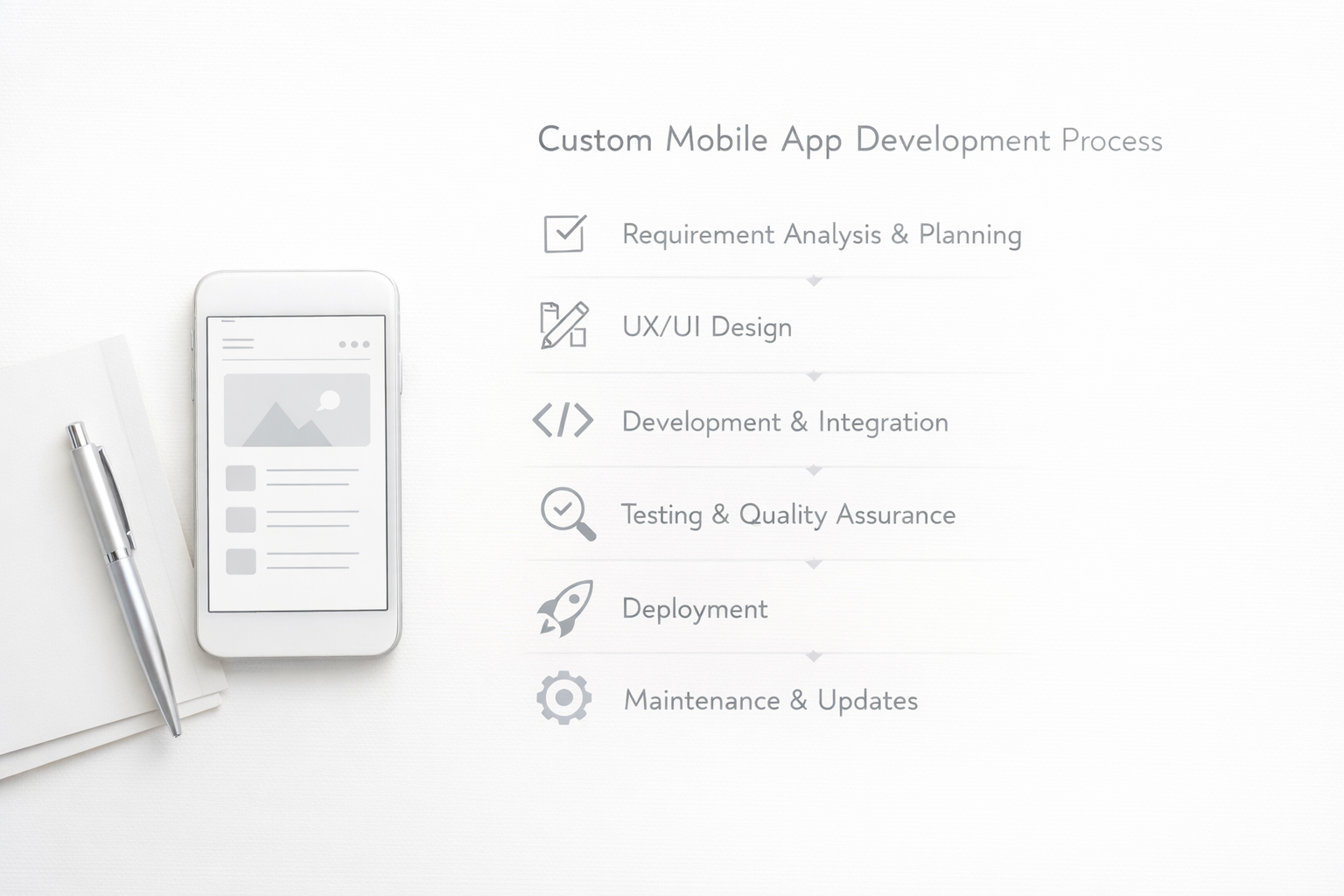
Custom mobile software development process stages: requirement analysis, UX/UI design, development and integration, testing and quality assurance, deployment, maintenance and updates with minimalistic icons and a smartphone wireframe

A structured development process ensures quality and reduces risk. Custom mobile software development generally follows these stages:

  1. Requirement analysis and planning
  2. UX/UI design
  3. Development and integration
  4. Testing and quality assurance
  5. Deployment
  6. Maintenance and updates

Each stage ensures the application meets functional, technical, and user expectations.

iOS, Android, and Cross-Platform Development

Custom mobile apps can be built for:

  • iOS
  • Android
  • Cross-platform frameworks

The right choice depends on target audience, budget, performance needs, and long-term goals. Custom development allows businesses to choose the most suitable approach rather than being locked into one platform.

Long-Term Value of Custom Mobile App Development

While custom apps may require more initial planning, they offer better long-term value by reducing limitations, improving performance, and supporting growth.

Businesses benefit from:

  • Lower maintenance costs over time
  • Better user retention
  • Easier feature upgrades
  • Improved data security
  • Stronger brand consistency

Custom apps are built to evolve rather than be replaced.

Why Businesses Work With Qualix Solutions

Qualix Solutions delivers custom mobile app development services focused on practical business outcomes. Our approach prioritizes clean architecture, performance optimization, and scalable design.

We support:

  • Startups launching MVPs
  • Businesses modernizing mobile platforms
  • Enterprises building secure internal apps

By aligning technology with business strategy, we help clients build mobile solutions that deliver long-term value.

Conclusion

Custom Mobile App Development provides businesses with the flexibility, control, and scalability needed to succeed in a mobile-first world. Instead of adjusting your operations to a generic app, custom development ensures the app works around your business.

From startups to enterprises, investing in customized mobile app development creates a stronger foundation for growth, innovation, and user satisfaction.

For organizations seeking reliable custom mobile application development services, Qualix Solutions offers tailored mobile solutions built to perform, scale, and adapt.

FAQs

Will mobile application development be dead in 10 years?

Mobile application development is unlikely to disappear as businesses continue to rely on mobile experiences for users and operations. Instead, it will evolve with new technologies, platforms, and user behaviors.

How much does it cost to build a custom mobile app?

The cost of a custom mobile app depends on features, complexity, platforms, and integrations. Simple apps cost less, while advanced or enterprise apps require a higher investment.

Why is custom mobile app development a better choice in 2026?

In 2026, custom mobile apps offer better performance, security, and flexibility compared to generic solutions. They allow businesses to adapt quickly to changing user expectations and technologies.

Why do people think custom mobile app development is worth the investment?

Custom mobile app development is worth the investment because it provides long-term control, scalability, and a better user experience. Businesses avoid platform limitations and reduce future redevelopment costs.

When is the best time for your business to build a custom mobile app?

The best time to build a custom mobile app is when mobile users play a key role in customer engagement or operations. Early development helps businesses scale efficiently and stay ahead of competitors.


Relevant Guides & Services

.Net Development Company

Custom Web Development

CRM Maturity Model

UI/UX Design

Next.JS Development Company

Tags

What do you think?

Leave a Reply

Your email address will not be published. Required fields are marked *

Related articles

how top consultancies use ai and automation

How Top Consultancies Use AI and Automation

The way consulting firms operate is changing fast. If you look at how top consultancies use AI and automation today, the shift is not just about technology, it’s about speed, decision-making, and how teams deliver value. Firms that once relied heavily on manual research, spreadsheets, and long turnaround cycles are now using AI to compress timelines from weeks to hours. Automation is removing repetitive work, while AI systems are helping consultants focus on strategy instead of data cleanup. This guide breaks down how top consultancies use AI and automation tools across real business functions, what tools they rely on, and how these changes impact clients across industries in the USA and globally. What Does AI and Automation Mean in Consulting? Before diving into use cases, it’s important to understand what AI and automation actually look like in consulting environments. AI (Artificial Intelligence): Systems that analyze data, generate insights, predict outcomes, or create content Automation: Workflows that run without manual input (data syncing, reporting, alerts, task triggers) Together, they help consultancies: Reduce manual work Improve accuracy Deliver faster results Scale operations without increasing headcount Why Top Consultancies Are Investing in AI Top firms are not adopting AI for trend value, they are solving real operational problems. Key Drivers 1. Time Pressure from ClientsClients expect faster insights and real-time reporting, not weekly updates. 2. Data OverloadBusinesses now operate across dozens of tools, creating fragmented data. 3. Cost EfficiencyManual consulting hours are expensive. Automation reduces unnecessary workload. 4. Competitive AdvantageFirms that use AI deliver faster and more accurate recommendations. How Top Consultancies Use AI and Automation in the World Across global consulting firms, AI is now embedded into daily operations. The use cases are consistent whether you look at the USA, Europe, or Asia. 1. Automated Data Collection and Integration Consultancies connect systems like CRM, ERP, analytics platforms, and marketing tools to create a single data flow. Example:Instead of manually exporting reports, automation pipelines pull data from multiple sources into one dashboard. Impact: Eliminates data silos Reduces reporting errors Saves hours of manual work 2. AI-Powered Market Research Research teams now use AI tools to: Analyze competitor websites Summarize industry reports Identify trends from large datasets Example:A consultant can input a market query and get a structured analysis within minutes instead of days. Impact: Faster decision-making Better strategic recommendations 3. Predictive Analytics for Business Decisions AI models help consultancies predict: Sales trends Customer churn Demand forecasting Example:Instead of reacting to declining sales, consultants can identify risks early and suggest proactive actions. Impact: Data-driven strategy Reduced business risk 4. Workflow Automation Across Departments Automation connects different teams: Sales → Operations Marketing → CRM Finance → Reporting Example:When a deal is closed, automation triggers: Invoice creation Customer onboarding Internal task assignments Impact: Faster execution Better team alignment 5. AI for Client Reporting and Dashboards Consultancies are replacing static reports with dynamic dashboards powered by AI. Features include: Real-time data updates Automated insights Natural language summaries Impact: Clients get instant visibility Reduced reporting workload How Top Consultancies Use AI and Automation Tools To implement these use cases, firms rely on a mix of AI and automation tools. Common Tool Categories 1. Workflow Automation Platforms Automate repetitive tasks Connect different applications 2. AI Analytics Tools Forecast trends Analyze large datasets 3. CRM and Revenue Platforms Track customer journeys Automate sales processes 4. AI Content and Research Tools Generate reports Summarize data How Top Consultancies Use AI and Automation Tools for Business AI and automation are not limited to internal operations, they directly impact business outcomes. 1. Sales Optimization Consultancies use AI to: Score leads Predict deal success Automate follow-ups Result:Higher conversion rates and shorter sales cycles 2. Marketing Performance Automation helps: Track campaign performance Adjust strategies in real time Personalize messaging Result:Better ROI on marketing spend 3. Customer Experience AI enables: Personalized recommendations Faster support responses Behavior-based engagement Result:Improved customer retention 4. Financial Planning Automation ensures: Accurate forecasting Real-time financial reporting Reduced manual errors Result:Stronger financial control How Top Consultancies Use AI and Automation for Website Apps Consulting firms are also transforming how digital products are built and optimized. 1. AI-Driven Website Personalization Websites now adapt based on: User behavior Industry Traffic source Example:A visitor from a SaaS company sees different messaging than a manufacturing visitor. 2. Automated Lead Capture and Routing AI systems: Qualify leads instantly Route them to the right team Trigger follow-ups automatically 3. Chatbots and Conversational AI Websites now use AI assistants to: Answer queries Book meetings Guide users through services 4. Performance Optimization AI tools analyze: Page speed User behavior Conversion patterns Result:Continuous improvement without manual audits How Top Consultancies Use AI and Automation in the USA In the USA, adoption is more mature due to: Higher competition Advanced tech infrastructure Client expectations for real-time insights Key Trends in the USA Heavy use of predictive analytics Integration across 10–20+ tools AI-driven revenue operations Strong focus on data governance and compliance Consultancies in the USA are not just using AI, they are building entire service lines around it. Real-World Scenario: Before vs After AI Adoption Before AI and Automation Reports created manually Data scattered across tools Delayed decision-making High operational costs After AI and Automation Real-time dashboards Connected systems Faster strategic decisions Reduced manual workload Challenges Consultancies Face with AI Adoption Even top firms face challenges when implementing AI. 1. Data Quality Issues AI depends on clean, structured data. 2. Tool Overload Too many tools can create complexity instead of efficiency. 3. Change Management Teams need training to adopt new systems. 4. Integration Complexity Connecting multiple systems requires technical expertise. How to Start Using AI and Automation in Consulting If you’re looking to implement similar strategies, start with a structured approach: Step 1: Identify Repetitive Tasks Find processes that consume time but add little strategic value. Step 2: Map Your Tools Understand where your data lives and how systems interact. Step 3: Implement Automation First Start with workflows before introducing complex AI models. Step 4: Add AI for Insights Use AI for

Read more
where to buy ap automation software with ai-based fraud detection

Where to Buy AP Automation Software with AI-Based Fraud Detection

If you’re searching for where to buy ap automation software with ai-based fraud detection, you’re likely dealing with rising invoice volumes, fraud risks, and manual bottlenecks in your finance team. As an AI Accounts Payable Consultant, I’ve seen companies lose thousands due to duplicate invoices, fake vendors, and weak validation controls. The shift to AI-driven AP automation is no longer optional. It’s now a core financial control layer that combines invoice processing, fraud detection, and real-time data validation into one system. This guide will help you: Identify the best platforms Understand AI capabilities in AP Compare 20+ leading tools Choose the right solution for your business size   Top 23 AP Automation Platforms with AI-Based Fraud Detection   Below is a curated list of leading platforms globally. 1. Coupa Coupa offers advanced AI for spend analysis and fraud detection. It is widely used by enterprises for full procure-to-pay automation. 2. Stampli Stampli focuses on collaboration and invoice processing. Its AI assistant helps detect anomalies and automate approvals. 3. Rillion Rillion delivers strong invoice automation with built-in fraud detection features. It integrates well with ERP systems. 4. Tipalti Tipalti specializes in global payments and compliance. It uses AI to validate tax data and detect suspicious transactions. 5. AvidXchange AvidXchange focuses on mid-market businesses. It provides automated invoice processing and fraud monitoring tools. 6. Basware Basware offers strong AI-driven invoice processing and fraud detection capabilities for large enterprises. 7. Airbase Airbase combines AP automation with expense management. Its AI tools help detect duplicate payments and anomalies. 8. Bill.com Bill.com is popular among SMBs. It provides AI-driven invoice processing and payment automation. 9. Ramp Ramp focuses on cost control and fraud detection using AI-based transaction monitoring. 10. Melio Melio simplifies payments and invoice processing. It includes basic fraud detection features. 11. MineralTree MineralTree offers AI-powered invoice processing and payment fraud prevention tools. 12. Yooz Yooz provides strong OCR and AI-based invoice capture with anomaly detection features. 13. Kofax Kofax delivers advanced document processing and AI validation for invoices. 14. ABBYY ABBYY is known for AI-driven document recognition and invoice data extraction. 15. Sage Intacct Sage Intacct includes AP automation features with built-in fraud controls. 16. SAP Concur SAP Concur provides AP and expense automation with AI fraud detection capabilities. 17. Oracle NetSuite NetSuite offers integrated AP automation with real-time fraud detection. 18. Vic.ai Vic.ai is a leader in autonomous accounting. It uses AI for invoice coding and fraud detection. 19. Hypatos Hypatos focuses on deep learning for invoice processing and anomaly detection. 20. Rossum Rossum provides AI-based invoice capture and validation. 21. Tradeshift Tradeshift combines AP automation with supplier network intelligence and fraud detection. 22. Quadient AP Automation Quadient offers AI-powered invoice capture and workflow automation. 23. Beanworks Beanworks is a mid-market AP tool with automation and fraud monitoring features. Why AI-Based Fraud Detection is Critical in AP Automation Traditional AP systems rely on rules. AI-powered systems rely on patterns. That’s the difference between: Detecting fraud after it happens Preventing it before payment is made   Real-world problem: A mid-sized company approved invoices from a fake vendor for 3 months. Why? Because the system only checked PO matching, not behavioral anomalies. AI-based AP systems detect: Duplicate invoices across vendors Suspicious payment patterns Vendor impersonation Abnormal GL allocations This is where ai data verification solutions line item validation accounts payable becomes essential. What to Look for Before Buying AP Automation Software   Before deciding where to buy ap automation software with ai-based fraud detection, evaluate these core capabilities: 1. AI Invoice Recognition & Coding Look for tools offering: Automatic invoice capture Smart GL mapping Historical learning This is key for best ai-powered tools for automatic invoice coding and gl allocation. 2. Fraud Detection Engine The system should: Flag anomalies Detect duplicates Validate vendor behavior 3. ERP Integration Top tools integrate with: SAP Oracle ERP NetSuite This is crucial when evaluating top 20 ap automation tools with erp integration. 4. Touchless Processing Modern AP tools aim for: 80–95% invoice automation Exception-based workflows These are known as top touchless invoice engines with machine learning for exception handling. Best Use Cases by Business Size   Mid-Market Companies If you are looking for most cost-effective ai solutions for mid-market ap fraud prevention, consider: AvidXchange Yooz Beanworks These tools balance cost and functionality. Enterprise Companies For best enterprise systems for automating digital payment journeys 2026, top options include: Coupa Tipalti SAP Concur   AI-First Platforms For ap automation platforms using ai agents: Vic.ai Hypatos Rossum These tools go beyond automation and use agentic AI for decision-making. Real-Life Scenario: Fraud Prevention with AI AP   A logistics company processed 10,000 invoices monthly. Problem: Duplicate payments increased Manual approvals slowed operations After implementing AI AP automation: Fraud incidents dropped by 70% Invoice processing time reduced by 60% Finance team shifted from data entry to analysis   Where to Buy AP Automation Software with AI-Based Fraud Detection   You can purchase AP automation tools through: 1. Direct Vendor Websites Most platforms like Coupa or Tipalti sell directly. 2. Certified Implementation Partners Consulting firms help with: Tool selection Integration Custom workflows 3. Marketplaces & ERP Ecosystems Platforms like: Salesforce AppExchange SAP Store offer AP automation integrations. Key Trends for 2026 1. Agentic AI in AP AI agents will: Approve invoices Detect fraud Trigger workflows This aligns with best ap software with agentic ai add-ons for enterprises 2026. 2. Touchless AP Goal: 95% invoice automation 3. Real-Time Fraud Detection AI models will analyze transactions instantly. How to Choose the Right Solution Ask these questions: Does it integrate with your ERP? Can it detect fraud in real time? What is the automation rate? Does it support global payments?   Best AI-Powered Tools for Automatic Invoice Coding and GL Allocation – Final Thoughts Choosing where to buy ap automation software with ai-based fraud detection depends on your business size, ERP ecosystem, and risk exposure. The biggest mistake companies make is buying software without fixing their AP process. AI tools amplify your system. If your AP

Read more
how to use ai to automate tasks

How to Use AI to Automate Tasks for Real Business Impact

Artificial intelligence is no longer a future concept, it is already changing how companies operate daily. If you’re asking how to use AI to automate tasks, you’re likely dealing with repetitive work, disconnected systems, or manual processes slowing your team down. This guide explains how to automate tasks using AI, shows where it actually works, and gives you 60+ real-life use cases and 15 proven AI tools you can apply immediately. 60+ Real-Life Examples of AI Task Automation Sales (10 Examples) Auto-assign leads based on territory AI lead scoring using behavior Automated follow-up emails Call transcription and summaries Pipeline forecasting Meeting scheduling automation CRM data enrichment Deal risk prediction Proposal generation Sales activity logging Marketing (10 Examples) Email campaign personalization AI-generated ad copy Social media scheduling Content recommendations SEO keyword clustering Chatbot lead capture A/B testing automation Customer segmentation Landing page optimization Campaign performance insights Customer Support (10 Examples) AI chatbots for FAQs Ticket classification Auto-response suggestions Sentiment analysis Knowledge base recommendations Call routing automation Issue prioritization SLA monitoring Feedback summarization Self-service automation Operations (10 Examples) Invoice processing Order tracking automation Inventory forecasting Vendor communication automation Data reconciliation Report generation Workflow approvals Contract analysis Procurement automation Payment reminders IT & Engineering (10 Examples) Incident detection Log analysis Automated ticket resolution Code generation System monitoring Security threat detection Infrastructure scaling Deployment automation Backup management Password reset automation HR & Admin (10+ Examples) Resume screening Interview scheduling Employee onboarding workflows Payroll processing Policy compliance checks Internal helpdesk automation Performance tracking Exit process automation Document generation Meeting summaries Task reminders Internal communication automation How to Automate Repetitive Tasks Using AI Agents AI agents are one of the fastest-growing trends. If you’re exploring how to automate repetitive tasks using AI agents, here’s how they work: AI agents can: Take actions across tools Make decisions based on context Execute multi-step workflows Example: Customer submits request → AI agent checks CRM → updates record → sends response → logs activity How Can I Use AI to Automate My IT Tasks? For IT teams, AI is especially powerful. Examples: Automatically resolve support tickets Detect anomalies in system logs Predict outages before they happen Auto-scale infrastructure Generate scripts for repetitive fixes Real scenario: Instead of manually reviewing logs, AI identifies unusual patterns and alerts your team instantly. 15 Best AI Tools to Automate Tasks Here are the most effective tools across categories: Workflow Automation Zapier Make (Integromat) n8n AI & Language Models OpenAI (ChatGPT API) Claude Google Gemini Sales & RevOps HubSpot AI Salesforce Einstein Clari Marketing Automation Jasper AI Copy.ai Customer Support Intercom AI Zendesk AI IT Automation Moveworks Aisera Step-by-Step: How to Use AI to Automate Tasks 1. Identify Repetitive Work Start by listing tasks that are: Time-consuming Rule-based Repeated daily or weekly Examples: Data entry Lead qualification Email responses Report generation 2. Map Inputs and Outputs Every task has: Input → Data, trigger, or action Process → Rules or logic Output → Result Example: Input: New form submission Process: AI checks lead quality Output: Assign to sales + send email 3. Choose the Right AI Tool Different tools serve different purposes: Workflow automation Natural language processing Predictive analytics IT automation 4. Build AI Workflows This is where automation happens: Trigger → Action → Decision → Output Example: New lead → AI scores lead → If high intent → Notify sales → Send follow-up email 5. Monitor and Improve AI improves over time, but only if you: Track outcomes Adjust logic Train models with better data Why AI Task Automation Matters Now   Most teams today operate across 10–20 tools. Sales, marketing, operations, and IT often work in silos. The result: Delayed responses to leads Manual data entry errors Poor forecasting visibility Time wasted on repetitive tasks AI fixes this by: Automating decisions, not just actions Connecting systems through workflows Reducing human dependency on routine work What Does It Mean to Automate Tasks Using AI? When people ask how can I use AI to automate tasks, they often think about simple automation like scheduling emails. But AI goes further. AI automation includes: Understanding data (not just moving it) Making decisions based on patterns Triggering workflows automatically Learning from outcomes Example: Instead of manually assigning leads, AI analyzes behavior and assigns them to the best-performing sales rep automatically. How to Choose the Right Tasks to Automate Not everything should be automated. Focus on: High-frequency tasks Low-risk decisions Data-heavy processes Avoid: Strategic decision-making Complex human judgment tasks Common Mistakes to Avoid Automating broken processes Using too many tools without integration Ignoring data quality Not tracking performance Over-automating customer interactions AI Automation Use Cases That Drive Revenue If your goal is growth, focus on: Lead response automation (within 5 minutes) Forecasting accuracy improvements Customer retention workflows Sales pipeline visibility How AI Improves RevOps Strategy AI helps RevOps teams: Align sales, marketing, and finance Improve forecasting accuracy Eliminate data silos Increase revenue predictability Future of AI Task Automation In the next 2–3 years: AI agents will replace manual workflows Decision-making will become automated Businesses will rely less on manual operations How to Use AI to Automate Repetitive Tasks​ – FAQs   How to use AI to automate tasks? Start by identifying repetitive tasks, map inputs and outputs, choose AI tools, build workflows, and continuously optimize performance.   How can I use AI to automate repetitive tasks? Use AI tools to handle data entry, emails, reporting, and workflows. AI can analyze patterns and execute actions automatically. How to automate tasks using AI tools? Select tools like Zapier, HubSpot AI, or OpenAI. Create workflows with triggers, conditions, and actions. How can I use AI to automate my IT tasks? Use AI for ticket resolution, log monitoring, security detection, and infrastructure automation. How to automate repetitive tasks using AI agents? Deploy AI agents that can execute multi-step workflows, make decisions, and interact across systems. Relevant Guides & Services   CRM Software for Non Profit Organizations Catering Delivery Driver App Apps for Enterpreneurs Multimodal Communication Web3 iOS App Development Social Media App Development

Read more
Contact us

Partner with Us for Comprehensive IT

We’re happy to answer any questions you may have and help you determine which of our services best fit your needs.

Your benefits:
What happens next?
1

We Schedule a call at your convenience 

2

We do a discovery & consulting meeting 

3

We prepare a proposal 

Schedule a Free Consultation