Development

social media app development cost

Social Media App Development Cost and Budget Planning

If you are planning to build a new social app or platform, one of the first questions you must answer is how much it will cost. Social apps are complex products with many moving parts. Getting your budget right early can help you avoid surprises in planning, development, and growth. This guide explains the social media app development cost clearly and simply. It includes price ranges for different types of social apps, explains what drives the cost, and answers common questions like how much does it cost to build an app like Facebook and how much does it cost to run a social media website after launch. The goal is to help you plan your financial strategy with confidence. What Is Social Media App Development Cost? When we talk about social media app development cost, we mean the total money needed to build the app from idea to launch. This includes planning, design, coding, testing, and deployment. There is no fixed price that applies to all social apps. The real cost depends on the type of app you want to build, the features you include, the team that builds it, and the quality and scale you expect. Simple social apps that only allow basic posting and profiles cost much less than full featured platforms with video sharing, chat, real‑time updates, and admin tools. Based on market research, general development ranges are: Basic social app: $30,000 to $80,000 Mid level social app: $80,000 to $150,000 Complex or advanced app: $150,000 to $250,000 or more These figures include planning, design, development, and testing. 1. Main Factors That Affect Social Media App Development Cost A social media app has many parts. Each part costs time and money to build. Here are the main factors that shape the price. Features and App Complexity The number and quality of features are the biggest drivers of cost. A simple app with only user login and a basic feed costs much less than a full‑featured platform with messaging, video uploads, search, notifications, and analytics. Each feature adds time to development, and more complex features add more time. Features like live streaming or AI powered feeds push the cost higher. Platforms (iOS, Android, Web) Developing for one platform such as iOS costs less than building for both iOS and Android. Building a web version too adds additional time and cost. Cross platform tools like React Native or Flutter can reduce cost by letting you use one code base for both iOS and Android. Native tools cost more but give better performance. Design Good design takes time and expertise. Social media apps depend on user experience. You need clear menus, easy navigation, and attractive screens. User experience (UX) and user interface (UI) design will usually make up 10 to 20 percent of your total development cost. Backend and Infrastructure The backend is everything that makes the app work behind the scenes. This includes servers, databases, APIs, user data, feeds, messaging systems, and media storage. A good backend costs more, especially if you expect many users soon after launch. Building a scalable backend is one of the most expensive parts of social media app development. 2. Typical Cost Breakdown for Social Media App Development To understand social media app development cost, here is a breakdown of common stages and price ranges based on industry averages: Planning and Strategy Before development, you need an idea roadmap. This means defining the app features, target audience, technology stack, and user journey. Planning costs depend on how clear your idea is and whether you hire a business analyst or consultant. Typical budget: $2,000 to $10,000 depending on depth of research. User Interface and User Experience (UI/UX) Design work includes wireframes, mockups, user flow screens, and final design files. More screens and animations raise the price. Estimated cost: $8,000 to $40,000. Development (Coding) This includes frontend and backend development. Frontend is what users see. Backend is the system that manages data, servers, and logic. These costs depend on feature list and team rates. Basic app: $30,000 to $60,000 Mid level app: $80,000 to $150,000 Advanced app: $150,000 to $250,000+ (These are general ranges and may vary by team location and features.) Testing Testing the app for bugs, speed, and reliability is needed before launch. The more complex the app, the more testing you need. Typical cost: $5,000 to $20,000. Launch and Deployment Publishing the app to Apple App Store and Google Play and ensuring servers are set up properly costs another part of your budget. Typical launch cost: $3,000 to $10,000. 3. Example Costs by App Type Prices vary widely depending on how advanced your app is. Below are typical cost ranges: Basic Social App A simple social network that allows user login, profiles, basic posting, and a feed. Basic features can be done with less backend work. Estimated social media app development cost: $30,000 to $80,000. Medium Social App This includes photo and video sharing, push notifications, messaging, search, and simple social features. Estimated cost: $80,000 to $150,000. Advanced Social App This includes live video streaming, advanced messaging, complex search, community tools, ads management, and analytics. Estimated cost: $150,000 to $250,000+. 4. How Much Does It Cost to Build an App Like Facebook? When people ask how much does it cost to build an app like Facebook, they usually mean a full platform with many features and potential for millions of users. Facebook is one of the largest social platforms in the world. To build a full clone with similar capabilities is a major project. A fully featured app like Facebook, with personalized feeds, large profile systems, social groups, real time chat, marketplace tools, photo and video sharing, and admin controls will cost much more than a simple or mid range app. General estimates for a Facebook scale app range from $200,000 to $500,000 or more depending on features and team quality. A minimum viable version (MVP) of a Facebook style app with basic features may cost less, but a scalable version that

Read more
agile software development

What Is Agile Software Development? Principles, Methodologies, and Benefits for Businesses

Is your company’s project management approach holding back innovation and speed to market? Traditional methods often struggle to keep up with shifting customer demands. This modern framework, rooted in the 2001 Agile Manifesto, prioritizes adaptability and customer collaboration over rigid plans. In 2001, seventeen software practitioners formalized these principles in the Agile Manifesto, a foundational document published by the Agile Alliance. It represents a fundamental shift in how teams build products. Instead of lengthy cycles, work progresses in short, iterative sprints. This allows for continuous feedback and immediate adjustments. The result is a dynamic process that delivers high-quality outcomes faster. Organizations can pivot quickly when market conditions change, ensuring their projects stay aligned with core business goals. This guide will unpack its core principles and popular methodologies. Leaders from startups to large enterprises will learn how to leverage this approach for tangible advantages like improved efficiency and sustained growth. Key Takeaways Agile is a modern project management philosophy emphasizing flexibility and rapid response to change. It originated from the Agile Manifesto, created by 17 software practitioners in 2001. The approach breaks projects into smaller, manageable iterations called sprints. It fosters closer collaboration between development teams and customers or stakeholders. Businesses can achieve faster time-to-market and better align projects with evolving goals. Both startups and large enterprises can scale this methodology to improve outcomes. Adopting these practices can transform a company’s innovation cycle and market responsiveness. What Is Agile Software Development? A transformative approach to building products focuses on rapid iterations and customer input. This framework prioritizes delivering functional increments frequently, often every few weeks. Defining Agile in the Modern Context Modern agile software development is a cultural shift. It empowers team members to make decisions based on real-time project needs. The definition centers on an iterative process. It values customer satisfaction through early and continuous delivery of valuable software. This mindset moves away from documentation-heavy, rigid processes of the past. Teams now embrace adaptability and direct collaboration. The Agile Manifesto and Its Origins In 2001, seventeen programmers met in Snowbird, Utah. Key figures included Kent Beck, Jeff Sutherland, and Ken Schwaber. They sought to define lightweight methods for software development. This meeting produced the Agile Manifesto, solidifying core values for current practices. While roots trace back to 1957, the 2001 gathering was pivotal. It framed programming as a collaborative, human-centric endeavor rather than a rigid task. Aspect Traditional Plan-Driven Approach Modern Agile Approach Project Planning Detailed, upfront specification Adaptive, iterative roadmap Feedback Cycles Lengthy, often at project end Short, continuous sprints Team Structure Hierarchical, role-specific Cross-functional, collaborative Documentation Extensive, mandatory Minimal, just enough Core Agile Principles and Values These foundational beliefs prioritize human elements and tangible results above all else. The Agile Manifesto outlines twelve guiding principles for flexible and efficient work by modern teams. Individuals and Interactions Over Processes and Tools This core value states that people and communication drive success. Empowered teams who collaborate directly deliver more value than those bound by rigid procedures. The right tools support, but do not replace, effective teamwork. This belief fosters a culture of trust and open dialogue. Working Software and Customer Collaboration Delivering functional working software frequently is the primary measure of progress. It provides tangible value to the customer early in the lifecycle. Constant collaboration with the customer replaces fixed contracts. This partnership allows product needs to evolve smoothly with stakeholder input. Focus Area Traditional Emphasis Agile Value Priority Team Dynamics Following strict processes and using mandated tools Individuals, interactions, and team communication Project Deliverables Comprehensive documentation and plans Frequent delivery of working software Stakeholder Relationship Contract negotiation and fixed requirements Ongoing customer collaboration and feedback Exploring Agile Methodologies and Frameworks Several structured frameworks exist to translate agile principles into daily practice. These agile methodologies provide clear roadmaps for teams. They turn adaptive values into consistent project management actions. Each framework offers unique tools for iterative progress. Scrum: Roles, Sprints, and Standups Scrum is a popular framework formalized in 1995. It uses fixed-length cycles called sprints, usually two weeks long. Three key roles guide the process. The Product Owner defines goals. The Scrum Master facilitates the team. The Development Team delivers increments. Daily stand-up meetings keep everyone aligned. This structure handles complex work effectively. Kanban, Lean, and XP: Alternative Approaches Kanban offers a visual approach to workflow. Teams use boards to track tasks and limit work in progress. Extreme Programming, or XP, emerged in 1996. It emphasizes technical practices like pair programming. Two developers work together at one workstation. Lean thinking focuses on cutting waste. It maximizes value in product development. Feature-Driven Development followed in 1997. Methodology Primary Focus Key Practice Best For Scrum Iterative progress via sprints Daily stand-up meetings Complex projects with changing needs Kanban Visualizing workflow and limiting work in progress Using a Kanban board Continuous delivery and maintenance Extreme Programming (XP) Technical excellence and customer satisfaction Pair programming Teams needing high code quality Lean Maximizing value by eliminating waste Value stream mapping Large-scale environments optimizing efficiency The Agile Lifecycle and Iterative Development A structured yet flexible lifecycle drives continuous value delivery in product creation. This process relies on short, time-boxed periods called iterations or sprints.   These cycles typically last from one to four weeks. They allow teams to manage complexity while maintaining a steady pace. Sprint Planning and Backlog Management During sprint planning, the team selects the most important tasks from the product backlog. This focus ensures the next iteration delivers maximum value to the customer. Effective backlog management keeps priorities clear for the upcoming sprint and future iterations. Everyone understands the immediate goals. Iterative Testing and Continuous Integration Continuous integration is a vital practice in the agile software development lifecycle. Code changes merge frequently to detect issues early. Each iteration concludes with a review of working software. Stakeholder feedback gathered here directly informs the next planning session. Agile vs Waterfall: A Comparative Analysis Two dominant philosophies guide how teams manage their projects: Agile and Waterfall. The Waterfall model requires completing phases like requirements

Read more
what is software development

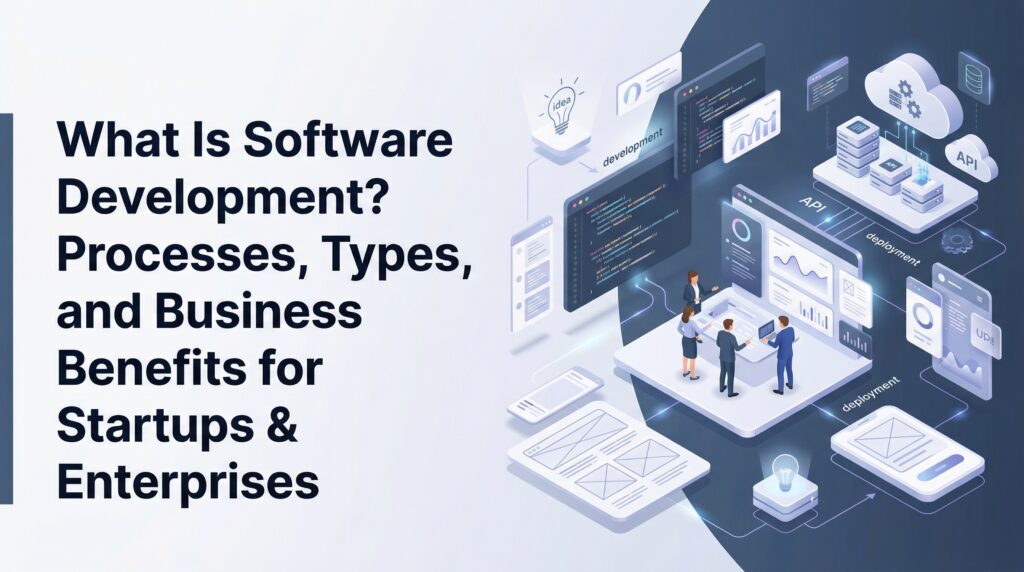
What Is Software Development? Processes, Types, and Business Benefits for Startups & Enterprises

Is your company’s digital infrastructure merely keeping the lights on, or is it engineered to drive explosive growth? Software development drives one of the fastest-growing sectors in the global economy. Industry reports from Grand View Research estimate the market at over $730 billion in 2024, with projected growth exceeding $1.3 trillion by 2030 at an annual rate of more than 11%. For organizations across the United States, mastering this lifecycle is non-negotiable. It turns vague ideas into precise, functional tools that meet specific business goals and user demands. Modern teams rely on structured frameworks, like the Software Development Life Cycle (SDLC). These interconnected steps ensure every line of code serves a strategic purpose. By leveraging agile methodologies and continuous testing, businesses build scalable, secure systems. These systems deliver long-term value and a formidable competitive edge. This guide breaks down the core processes, various application types, and tangible benefits professional software development brings to ambitious companies. The increasing reliance on software across industries, from cloud computing to artificial intelligence, continues to drive massive global investment, with enterprise software spending expected to approach $1 trillion annually, according to data from Statista. Key Takeaways Software development is a structured process for creating and maintaining digital applications. It powers a massive and rapidly growing global economy. A defined lifecycle (SDLC) is crucial for aligning technical work with business strategy. Modern methodologies help build scalable and secure systems for the future. Professional development transforms digital infrastructure into a key driver of business value. Understanding different software types is essential for selecting the right solution. The ultimate goal is to create efficient tools that meet specific user and organizational needs. Introduction to Software Development The modern business landscape is fundamentally shaped by programmable systems that operate independently of physical machines. These digital instructions form the backbone of everything from utility grids to personal devices. This foundational layer enables the creation of tailored applications. Companies leverage these tools to carve out unique market positions. Setting the Stage for Digital Innovation Digital innovation thrives on automation. Complex tasks are handled by code, allowing operations to scale efficiently. Manual labor costs no longer rise proportionally with growth. This efficiency drives the current 11.7% annual market growth in the United States. The Role of Software in Modern Business Modern enterprises use applications to integrate disparate systems. Seamless data flow between departments boosts organizational efficiency. The role of these programs has evolved. Simple utilities have become complex, cloud-native ecosystems supporting millions of businesses daily. Aspect Traditional Approach Software-Driven Approach Primary Impact Data Management Manual filing, spreadsheets Centralized databases, real-time analytics Faster, accurate decisions Process Automation Repetitive human tasks Automated workflows, bots Lower costs, higher output Customer Interaction In-person, phone calls 24/7 digital portals, apps Improved service, global reach This shift underscores why professional software development is critical. It transforms static infrastructure into a dynamic engine for value creation. What is Software Development: Definition and Scope The global demand for digital solutions underscores the importance of a well-defined creation process. This field involves the comprehensive steps of defining, building, testing, and maintaining applications. It supports a market valued at $429 billion. Understanding the Core Concepts Software engineers and developers collaborate closely. They translate complex business needs into functional code. The final product must align with user expectations. The scope of this work is broad. It includes system, application, and embedded programs. Each type requires specialized programming languages and tools. Effective planning and requirements management are critical. Teams define the project scope before writing a single line. This upfront work prevents costly changes later. Type Primary Function Common Tools & Languages Typical Use Case System Software Manages hardware and basic operations C, C++, Assembly Operating systems, drivers Application Software Performs specific tasks for users Java, Python, JavaScript Web apps, mobile apps, business tools Embedded Software Controls dedicated hardware devices C, Rust, specialized IDEs Medical devices, automotive systems A structured approach ensures products are secure and maintainable. This methodology delivers long-term value throughout the entire lifecycle. The Software Development Lifecycle (SDLC) Explained A structured framework guides every successful project from initial concept to long-term support. This lifecycle, known as the SDLC, provides a roadmap for teams to build robust applications. It standardizes the development process to enhance quality and manage risk. Following these phases ensures the final product aligns with business goals. SDLC Stages: Planning to Maintenance The software development process typically involves seven key phases: Planning: Defining project scope and objectives. Analysis: Gathering detailed requirements. Design: Creating system architecture. Implementation: Writing the actual code. Testing: Identifying and fixing bugs. Deployment: Releasing the application to users. Maintenance: Providing updates and support. Each stage feeds into the next, creating a logical flow. Software engineers rely on this sequence to embed security and scalability early. Best Practices and Process Optimization Modern teams integrate continuous testing throughout the lifecycle. This approach catches defects long before deployment. Regular feedback loops with stakeholders are crucial. They ensure the product evolves according to user needs. Standardizing the deployment maintenance cycle leads to predictable outcomes. It also helps developers meet regulatory requirements efficiently. Comparing Development Methodologies The 2001 Agile Manifesto marked a pivotal shift in how engineers approach complex projects. Teams now select from several established models to guide their work. Each framework offers distinct advantages for managing scope, risk, and delivery. Agile vs Waterfall: Key Differences and a Comparison Table The Waterfall model is a linear, sequential approach. Each phase, like planning or design, must finish before the next begins. This method suits projects with highly stable, well-defined requirements. Changes later in the process are difficult and costly. Agile methodology prioritizes flexibility and customer feedback. Work occurs in short, iterative cycles called sprints. This allows teams to adapt quickly to new information or shifting priorities. It is ideal for dynamic environments. Aspect Waterfall Model Agile Methodology Ideal Project Type Approach Linear & Sequential Iterative & Cyclical Waterfall: Stable specs. Agile: Evolving needs. Flexibility Low; changes are costly High; adapts each sprint Waterfall: Fixed contracts. Agile: Market-driven. Customer Involvement Mainly

Read more
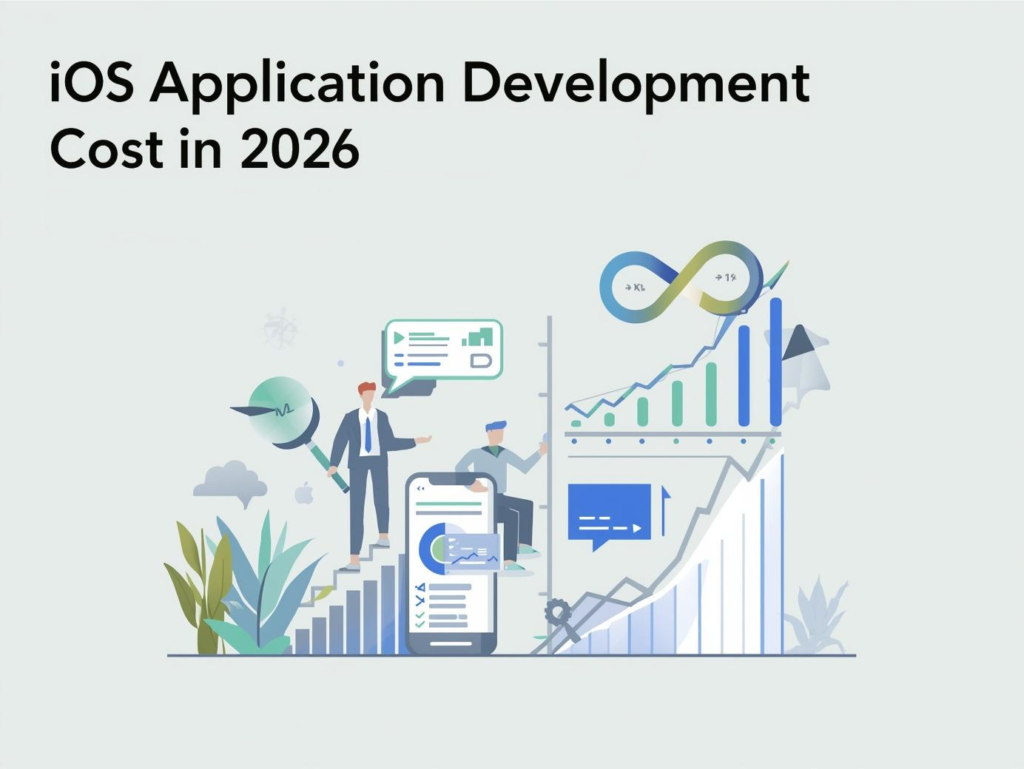
Illustration showing iOS application development cost in 2026 with business growth charts, mobile app interface, and performance analytics dashboard.

iOS Application Development Cost in 2026: A Complete Business Breakdown

Developing an iOS app in 2026 requires more than just a development budget. The iOS application development cost depends on how the app is designed, how it scales, and how it supports business goals over time. Companies that understand these factors early avoid cost overruns and build more sustainable products. This guide explains what drives iOS app costs, how pricing varies by app type, and what businesses should budget realistically. The average cost to develop an iPhone app in 2026 varies widely based on functionality and technical requirements. The final iOS app development cost reflects how much customization, backend infrastructure, and long-term support the app requires. App Scope and Feature Set The number and complexity of features directly affect the cost to create an app for iPhone. Apps with basic content and navigation cost significantly less than those requiring real-time data, integrations, or advanced logic. Custom iPhone app development increases upfront cost but delivers stronger performance, better security, and easier future upgrades. Businesses that choose custom development reduce long-term maintenance issues and platform limitations. Design plays a major role in the iOS app development price. Apps with branded layouts, animations, and user-focused flows require more design and testing effort than template-based interfaces. Apps that store data, support user accounts, or process transactions need backend systems. These elements increase the cost of developing an app due to: Ensuring compatibility across iOS versions and Apple devices adds time and cost. Proper testing reduces post-launch issues and improves user retention. Basic iOS Applications These apps include static content, limited interactions, and no backend systems. Business and Startup Apps These apps support user accounts, payment systems, and admin features. Enterprise-Level iOS Apps Enterprise apps handle large user volumes, advanced security, and complex integrations. App Type Typical Use Case Price Range Basic App Informational, MVP $15,000 – $25,000 Startup / Business App Booking, eCommerce, dashboards $30,000 – $60,000 Enterprise App Large-scale users, integrations $70,000 – $150,000+ AR iOS App ARKit, 3D rendering $60,000 – $150,000+ The cost to develop AR application in iOS is higher due to specialized requirements such as 3D rendering and real-time processing. AR apps typically start at $60,000 and can exceed $150,000, depending on complexity and performance demands. Apple requires developers to maintain an active account to publish apps. Licence Cost Account Cost for Enterprises These fees are fixed and must be included in overall cost planning. Initial development is only part of the total investment. Ongoing expenses affect the long-term cost of developing an app. Common post-launch costs include: Annual maintenance typically ranges from 15% to 25% of the original development cost. Mobile App Development for iOS: Cost vs Value The lowest-priced app often becomes the most expensive over time due to poor scalability and frequent fixes. High-quality mobile app development for iOS focuses on long-term stability, performance, and user experience. A well-built app: Businesses can manage costs effectively by: Clear planning prevents unnecessary rework and delays. Reliable iOS mobile app development services provide: The right partner helps balance budget constraints with product quality. The iOS application development cost in 2026 depends on thoughtful planning, clear requirements, and the right technical approach. From basic apps to complex AR solutions, understanding cost drivers allows businesses to invest wisely. Instead of focusing solely on initial pricing, successful companies plan for long-term value, performance, and scalability. When built correctly, an iOS app becomes a strategic business asset rather than a recurring expense. FAQs How much does it cost to build a fully featured iOS app in 2026? A fully featured iOS app in 2026 typically costs between $30,000 and $150,000 or more. The final cost depends on features, integrations, design complexity, and scalability needs. Flutter can reduce development costs for multi-platform apps, but native iOS often delivers better performance and stability. The right choice depends on long-term goals, user experience needs, and app complexity. AI platforms can reduce costs by speeding up development, testing, and design workflows. However, human expertise is still essential for architecture, security, and quality assurance. Building an iOS app usually takes 3 to 6 months, depending on scope and complexity. Advanced or enterprise-level apps may require longer timelines for testing and integrations. Yes, iOS apps require regular updates to stay compatible with new iOS versions and devices. Ongoing maintenance also improves security, performance, and user experience over time.   Relevant Guides & Services What Are the Top Features of Supply Chain Management Software .Net Development Company Custom Web Development Custom Mobile App Development UI/UX Design Qualix Solutions Next.JS Development Company

Read more
Contact us

Partner with Us for Comprehensive IT

We’re happy to answer any questions you may have and help you determine which of our services best fit your needs.

Your benefits:
What happens next?
1

We Schedule a call at your convenience 

2

We do a discovery & consulting meeting 

3

We prepare a proposal 

Schedule a Free Consultation