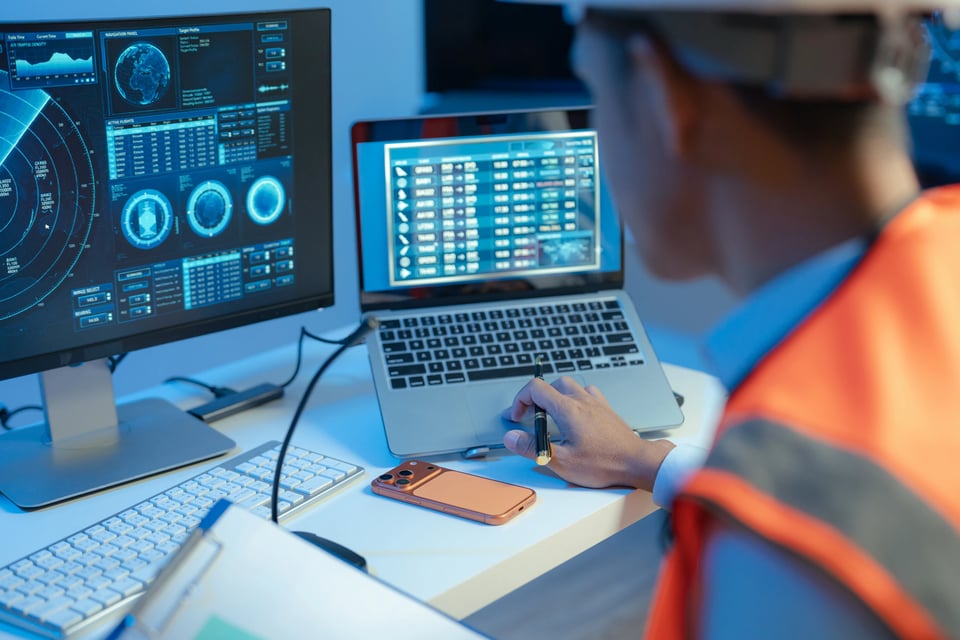
Construction accidents rarely happen without warning.
Unsafe equipment movements, repeated near misses, missed inspections, and poor working conditions often reveal risks before someone gets hurt.
The problem is that many construction companies collect this information without using it to prevent accidents.
Construction safety predictive analytics software helps companies recognize these warning signs earlier.
These platforms analyze safety records, inspections, worker activities, equipment conditions, and other operational data to identify potential hazards.
Some software uses machine learning to forecast future incidents.
Other platforms use cameras, sensors, and artificial intelligence to detect dangerous conditions as they develop.
Choosing the right platform depends on your construction projects, existing technology, safety requirements, and available data.
This guide covers the 17 best construction safety predictive analytics software options for 2026, including their capabilities, ideal users, and limitations.
17 Best Construction Safety Predictive Analytics Software in 2026
The following platforms cover construction-specific safety prediction, AI hazard monitoring, enterprise risk intelligence, and safety reporting.
The selection considers verified product capabilities, industry relevance, data analysis methods, and practical value for safety teams.
The order is an editorial shortlist rather than a ranking based on independent performance testing.
1. Autodesk Construction IQ — Best for Construction Project Risk Prediction
Autodesk Construction IQ is a strong option for contractors who want to identify safety risks using information already collected during project execution.
Available through Autodesk construction software environment, Construction IQ applies machine learning to project information and highlights issues requiring attention.
Its safety risk analysis helps managers identify hazardous conditions, problematic safety behaviors, and projects with elevated exposure.
Key capabilities: Machine learning, project risk prioritization, safety issue analysis, and quality risk identification.
Best for: General contractors, construction managers, and organizations using Autodesk construction products.
Limitations: Results depend on the quality and completeness of project records. Construction IQ does not detect every hazard.
Construction IQ is particularly useful when a company wants predictive insights connected to everyday construction management.
2. Oracle Construction Intelligence Cloud Newmetrix — Best for Custom Safety Risk Forecasting
Oracle Construction Intelligence Cloud (CIC) Newmetrix offers one of the clearest examples of dedicated predictive safety modeling.
Its Safety Risk Forecast capability uses organizational data, including projects, safety observations, and incidents, to develop a customized risk prediction model.
The objective is to identify projects with a greater likelihood of future safety problems.
Oracle assesses the available information before building the model.
When the data cannot support reliable forecasting, a nonpredictive benchmark model may be used instead.
Key capabilities: Custom risk models, project-level forecasts, safety dashboards, and incident-warning analysis.
Best for: Large construction companies with substantial historical safety data.
Limitations: Implementation requires data preparation and model assessment. Buyers should confirm current licensing and availability directly with Oracle.
This approach is valuable for organizations seeking formal risk forecasts rather than basic dashboards.
3. Intelex SafetyNet — Best for Predictive Safety Observations
Intelex SafetyNet focuses on predicting workplace injuries from safety inspections and observations.
The platform collects field information and analyzes leading indicators to identify locations, activities, or operational patterns that deserve additional attention.
Safety professionals can use these findings to determine where preventive action is most necessary.
Unlike systems that concentrate on reporting accidents after they occur, SafetyNet is designed around proactive safety measurement.
Key capabilities: Predictive analytics, mobile safety observations, inspection data collection, and real-time risk reporting.
Best for: Construction companies and industrial organizations with established observation programs.
Limitations: Prediction quality depends on consistent reporting and representative inspection data.
SafetyNet is a relevant choice for companies that already collect large volumes of safety observations but struggle to turn those records into preventive decisions.
4. Benchmark Gensuite Risk AI Advisor — Best for Enterprise Risk Intelligence
Benchmark Gensuite Risk AI Advisor helps large organizations identify emerging safety risks across multiple worksites.
The platform analyzes incidents, safety observations, employee concerns, and other records to identify significant risk patterns.
Its AI capabilities can highlight potential serious-incident precursors and notify responsible stakeholders.
Safety leaders can use these findings to prioritize corrective actions, training, and operational reviews.
Key capabilities: AI risk analysis, precursor identification, automated notifications, and enterprise safety reporting.
Best for: Large construction groups, industrial contractors, and manufacturing businesses.
Limitations: Organizations need reliable, consistently recorded safety information to obtain meaningful insights.
Benchmark Gensuite is worth evaluating when risk information is spread across departments or locations.
5. Procore Safety Hub and Insights — Best for Connected Construction Safety Management
Procore helps contractors manage safety information alongside project operations.
Its Safety Hub brings observations, inspections, and incidents into one environment, helping safety managers identify developing issues across projects.
Procore Insights provides additional visibility into performance trends and operational risks for eligible customers.
This makes Procore useful for construction businesses seeking better safety decisions without managing another disconnected reporting system.
Key capabilities: Safety observations, inspections, incident tracking, risk insights, and portfolio reporting.
Best for: General contractors and construction businesses already using Procore.
Limitations: Safety reporting and risk insights should not be confused with a dedicated incident probability model. Feature availability depends on the plan and rollout status.
6. HammerTech Intelligence — Best for Construction Safety Trends
HammerTech Intelligence supports safety professionals by improving the quality and usefulness of construction safety records.
Its AI capabilities help process observation information, capture safety meeting details, and identify trends across site activities.
For example, a contractor can review recurring housekeeping problems or fall-protection concerns across several projects.
This gives safety teams better information for planning inspections and preventive interventions.
Key capabilities: AI-assisted observations, safety reporting, trend identification, and construction-focused documentation.
Best for: Commercial contractors, industrial construction firms, and safety departments managing multiple subcontractors.
Limitations: Its documented strengths are safety intelligence and workflow analysis rather than guaranteed incident forecasts.
HammerTech is a practical option when improving safety data collection is the immediate priority.
7. viAct — Best for AI Construction Site Hazard Detection
viAct uses computer vision and connected monitoring technology to detect dangerous activities on construction sites.
The platform can analyze camera footage for missing protective equipment, unsafe work at height, restricted-area entry, and worker proximity to heavy machinery.
Its monitoring capabilities also extend to sensors, wearables, and certain specialized equipment environments.
Instead of waiting for an inspector to observe every unsafe condition, viAct provides continuous monitoring of configured hazards.
Key capabilities: AI video analytics, PPE detection, proximity warnings, fall-risk monitoring, and safety dashboards.
Best for: High-risk construction sites, infrastructure projects, and industrial facilities.
Limitations: Detection performance depends on camera coverage, site conditions, and configuration.
viAct is particularly relevant for sites where hazards change throughout the day.
8. Intenseye — Best for Industrial and Heavy Manufacturing Safety
Intenseye specializes in identifying serious workplace hazards through AI-powered computer vision.
Its technology monitors video feeds to identify potentially dangerous interactions between workers, equipment, and operating environments.
The platform supports detection of vehicle-related risks, unsafe access, protective equipment problems, and ergonomic concerns.
Safety teams can review patterns across shifts and locations to understand where exposure is increasing.
Key capabilities: Real-time hazard detection, serious-injury precursor monitoring, ergonomic analysis, and risk reporting.
Best for: Heavy manufacturing, industrial operations, and facilities with machinery-intensive work.
Limitations: Industrial camera monitoring may require additional planning before deployment on changing outdoor construction sites.
Intenseye is especially relevant where preventing worker-equipment incidents is a priority.
9. Protex AI — Best for Predictive Industrial Safety Insights
Protex AI turns existing camera infrastructure into a source of safety and operational information.
Its platform identifies leading indicators such as unsafe vehicle proximity, PPE violations, restricted-zone activity, and ergonomic risks.
Protex Intelligence also supports investigation of recurring patterns and operational conditions that contribute to safety problems.
This helps managers move beyond identifying individual violations toward understanding why they repeatedly occur.
Key capabilities: Computer vision, near-miss detection, risk trend analysis, root-cause insights, and operational reporting.
Best for: Industrial manufacturers, warehouses, logistics facilities, and construction-related production operations.
Limitations: Its primary applications focus on industrial facilities rather than general construction project management.
10. Voxel AI — Best for Continuous Workplace Safety Monitoring
Voxel AI analyzes video from existing cameras to identify unsafe workplace conditions and repeated exposure patterns.
Its safety capabilities cover vehicle movements, pedestrian interactions, PPE compliance, ergonomics, and restricted areas.
The platform helps organizations compare risks across locations and measure whether corrective actions improve conditions.
This approach is particularly useful when managers need continuous visibility into facilities that operate across several shifts.
Key capabilities: Video safety monitoring, risk scoring, trend analysis, corrective-action tracking, and site reporting.
Best for: Heavy manufacturing, industrial facilities, and material-handling operations.
Limitations: Camera-based analytics depend on visibility and do not replace equipment safeguards or physical inspections.
Voxel is suitable for businesses that want stronger evidence of changing safety conditions.
11. Everguard.ai Sentri360 — Best for Sensor-Based Worker Protection
Everguard.ai Sentri360 combines multiple monitoring technologies to identify potential worker safety threats.
Its approach brings together computer vision, wearables, location information, and other sensors to monitor hazardous conditions.
The system can support proximity warnings, PPE monitoring, and alerts relating to dangerous worker-equipment interactions.
This is particularly relevant in environments where large vehicles, moving materials, and heavy machinery operate near people.
Key capabilities: Sensor fusion, proximity detection, wearable alerts, environmental monitoring, and safety analytics.
Best for: Industrial construction, steel production, and heavy manufacturing.
Limitations: Hardware deployment, sensor maintenance, and site integration can increase implementation requirements.
12. VelocityEHS Accelerate — Best for Connected Safety and Ergonomic Risk Analysis
VelocityEHS Accelerate combines workplace safety, ergonomics, and operational risk management.
Its VelocityAI capabilities analyze EHS information to identify patterns and support earlier intervention.
The platform is especially relevant where physical strain, repetitive movement, and equipment-related activities contribute to worker injuries.
Safety teams can connect inspection records, observations, incident information, and corrective actions.
Key capabilities: AI-assisted risk analysis, ergonomic assessments, incident management, safety dashboards, and corrective-action workflows.
Best for: Industrial contractors, manufacturing facilities, and large organizations managing several safety programs.
Limitations: Buyers should confirm which predictive and ergonomic capabilities are included in their selected package.
13. Cority — Best for Enterprise EHS Predictive Analytics
Cority supports companies that need to connect safety information across multiple business functions and locations.
Its EHS platform provides incident management, compliance tracking, operational reporting, and analytics.
CorInsights adds analytical capabilities that help organizations examine safety information and recognize developing patterns.
This is useful when managers need to compare exposure, incidents, and performance across facilities.
Key capabilities: EHS analytics, risk visibility, incident reporting, safety performance monitoring, and enterprise dashboards.
Best for: Large contractors, industrial manufacturers, and organizations with complex EHS requirements.
Limitations: Enterprise implementation can require considerable data mapping and process configuration.
Cority is a strong candidate when construction safety forms part of a wider corporate risk management program.
14. SpheraCloud — Best for Operational and Process Safety Risk
SpheraCloud helps organizations connect safety, operational risk, and compliance information.
Its capabilities support incident reporting, risk assessments, corrective actions, and enterprise performance analysis.
Sphera's 2026 AI developments also emphasize dynamic risk management, including identifying conditions where exposure is increasing.
This is important when construction activities involve complex industrial processes, hazardous materials, or equipment isolation.
Key capabilities: Risk analysis, incident management, operational intelligence, process safety, and AI-assisted risk insights.
Best for: Industrial construction, energy projects, chemical facilities, and manufacturing.
Limitations: Specialized process safety functions may be unnecessary for smaller contractors managing conventional building projects.
15. Enablon — Best for Enterprise Safety and Risk Governance
Enablon supports organizations that need consistent safety management across projects, employees, and contractors.
The platform connects health and safety records, risk assessments, compliance information, and operational insights.
Its reporting environment helps managers identify control weaknesses and monitor whether preventive actions are completed.
Enablon Open Insights also supports broader analysis of organizational safety and performance data.
Key capabilities: Risk assessments, safety management, operational reporting, compliance tracking, and enterprise analytics.
Best for: Infrastructure owners, large construction organizations, and industrial enterprises.
Limitations: Enablon's broad risk management capabilities should not automatically be treated as a dedicated machine-learning injury prediction system.
16. Safesite — Best Free Safety Analytics Starting Point
Safesite offers an accessible way for contractors to collect safety data and monitor leading indicators.
Its platform supports inspections, observations, hazard reporting, and corrective actions.
Safety scores and dashboards help managers identify recurring problems and track whether workplace conditions are improving.
Safesite offers a free plan, making it useful for businesses beginning to digitize safety operations.
Key capabilities: Mobile inspections, hazard management, leading-indicator analytics, and safety reporting.
Best for: Small contractors, subcontractors, and companies introducing digital safety management.
Limitations: Its analytics are not equivalent to a custom machine-learning incident prediction model. Free reporting has historical limits.
17. Mitti (Formerly SafetyCulture) — Best for Safety Inspections and Early Risk Visibility
Mitti, formerly SafetyCulture, helps construction teams collect consistent field information through digital inspections and checklists.
Safety managers can use inspection results, issue reports, and analytics to identify common hazards and incomplete corrective actions.
Its AI-assisted capabilities also support operational information management.
The free plan provides a starting point for small teams, while paid options offer more advanced reporting and integrations.
Key capabilities: Digital inspections, issue reporting, corrective actions, AI-assisted analysis, and safety dashboards.
Best for: Small and midsize contractors introducing structured field safety reporting.
Limitations: Basic inspection analytics do not independently provide validated incident forecasts.
Mitti works best as a foundation for collecting the information that more advanced predictive systems may require.
Which Construction Safety Predictive Analytics Software Should You Choose?
The right software depends on the type of risk your business needs to manage.
For construction companies with substantial historical data, Oracle CIC Newmetrix, Autodesk Construction IQ, Intelex SafetyNet, and Benchmark Gensuite deserve consideration because of their documented predictive capabilities.
For contractors already using construction management software, Procore and HammerTech can provide practical safety visibility within existing workflows.
For camera-based risk detection, viAct is particularly relevant to active construction environments.
For factories and industrial workplaces, Intenseye, Protex AI, and Voxel offer specialized monitoring capabilities.
Smaller contractors may benefit more from starting with Safesite or Mitti before investing in advanced prediction models.
The important decision is whether your business needs incident forecasting, immediate hazard detection, or better safety reporting. These requirements lead to different software choices.
Best AI-Powered Safety Analytics Software for Heavy Manufacturing
Heavy manufacturing requires more specialized safety monitoring than ordinary construction sites.
Manufacturing facilities often contain moving machinery, cranes, forklifts, robotic equipment, and repetitive production activities. Serious risks can develop even when general inspection compliance appears satisfactory.
Among AI-powered safety analytics platforms for heavy manufacturing, Intenseye, Protex AI, Voxel, Everguard.ai, and Benchmark Gensuite are relevant options.
Intenseye, Protex AI, and Voxel are strong candidates for identifying hazards through existing cameras.
Everguard.ai is relevant when sensor-based proximity warnings are required.
Benchmark Gensuite is suitable when organizations want to analyze incident records, observations, and risk patterns across multiple facilities.
Manufacturers should evaluate detection accuracy, privacy requirements, integration with existing equipment, and the ability to act on alerts.
Best Construction Safety Predictive Analytics Software Free Options
Free construction safety software is useful for collecting safety records, but advanced predictive modeling is rarely included in free plans.
Two options worth evaluating are Safesite and Mitti.
Safesite provides free access to inspections, hazard reporting, a safety dashboard, and leading-indicator information, subject to plan limits.
Mitti offers a free plan for small teams with inspection templates, basic analytics, and issue tracking.
Both platforms help establish consistent safety records. That information can support future predictive analysis.
However, neither should be purchased or adopted on the assumption that its free tier delivers the same forecasting capabilities as Oracle CIC Newmetrix or SafetyNet.
Best Construction Safety Predictive Analytics Software 2026 GitHub Options
GitHub provides open-source projects for testing computer vision and construction safety monitoring.
For example, the ppe-safety-checker project uses a YOLO-based object detection model to identify missing protective equipment in construction images and videos.
Developers can study this type of project to understand how image detection, violation logging, and safety alerts work.
However, detecting a missing helmet is not the same as predicting future injury probability.
A production-grade safety analytics platform also needs reliable datasets, testing, access controls, reporting, integrations, and ongoing model maintenance.
Construction companies considering GitHub solutions should review software licenses, data privacy, model accuracy, and commercial-use restrictions before deployment.
Open-source projects are useful for prototypes, research, and custom development. They are not automatically ready for live safety-critical operations.
Best Construction Safety Predictive Analytics Software Reddit - Perspective
Reddit discussions provide useful feedback about software adoption, but they are not independent product performance tests.
In construction and safety professional discussions, users frequently emphasize mobile usability, offline inspections, simple reporting, and integration with existing construction systems.
One recurring concern is data quality.
Predictive analysis becomes unreliable when inspections are inconsistent or near misses go unreported.
Discussions also question whether leading indicators alone can accurately predict injuries.
For buyers researching the best construction safety predictive analytics software on Reddit, the useful lesson is to evaluate day-to-day usability alongside analytical claims.
Software only becomes valuable when field teams use it consistently and managers respond to the information.
How Much Does Construction Safety Predictive Analytics Software Cost?
Software pricing depends on the number of projects, users, locations, cameras, integrations, and advanced analytical features.
Basic safety reporting tools may offer free plans or per-user subscriptions.
Enterprise predictive platforms often require custom quotations and implementation services.
Camera-based monitoring can introduce additional costs for edge hardware, video infrastructure, installation, and maintenance.
A useful purchasing approach is to calculate the complete cost of ownership rather than compare subscription prices alone.
Ask vendors to separate software licensing, setup, data preparation, integrations, training, support, and ongoing equipment costs.
How to Evaluate Predictive Safety Software Before Buying
A successful purchase starts with a specific safety problem, not a long feature checklist.
Review your data. Determine whether historical inspections, incidents, near misses, and corrective actions are complete enough for useful analysis.
Test real hazards. Ask vendors to demonstrate the risks your projects actually face, such as falls, vehicle proximity, or equipment access.
Check prediction quality. Request evidence of model validation, false alerts, missed hazards, and performance on comparable worksites.
Confirm integrations. Safety information should connect with construction management, reporting, and corrective-action systems where necessary.
Protect worker privacy. Establish clear rules for video retention, access, monitoring, and appropriate use of worker information.
Run a controlled pilot. Measure hazard detection, response time, reporting completeness, and corrective-action closure before a wider rollout.
Most importantly, predictive analytics should support trained safety professionals. It should never replace established physical controls, inspections, or safety procedures.
What Is Construction Safety Predictive Analytics Software?
Construction safety predictive analytics software uses historical and current workplace information to identify conditions associated with future accidents.
Instead of relying entirely on incident reports, predictive systems examine leading indicators such as unsafe observations, inspection failures, incomplete corrective actions, equipment hazards, and worker exposure.
For example, a construction project may experience repeated fall-protection violations. Predictive software can identify the increasing pattern and highlight the affected project or subcontractor for additional safety intervention.
Three types of technology support this process:
Predictive risk analytics: Uses statistical models and machine learning to estimate risk based on existing safety data.
Real-time hazard detection: Uses cameras, connected devices, or sensors to identify unsafe situations as they happen.
Safety performance analytics: Tracks inspections, incidents, near misses, and corrective actions to help managers identify recurring problems.
These capabilities are related, but they are not identical. A safety dashboard that displays previous incidents is not necessarily a predictive system.
How Qualix Solutions Can Help Build Custom Construction Safety Analytics Software
Off-the-shelf software is not always the right choice when construction companies have unusual workflows, disconnected systems, or specialized reporting requirements.
Qualix Solutions develops and modernizes custom software, including AI-enabled business applications and operational systems.
For construction businesses, custom development may involve connecting field inspection records, equipment information, project data, and reporting tools into one application.
A well-designed system can establish consistent data collection, automate safety-related workflows, and prepare information for appropriate analytical models.
Qualix Solutions has also delivered construction-related operational software, including a multi-site procurement and inventory management platform.
Companies exploring custom predictive safety technology should begin with a data and feasibility assessment before investing in model development.
Final Thoughts - AI-Powered Safety Analytics Platforms for Heavy Manufacturing
Best construction safety predictive analytics software in 2026 should help companies identify meaningful risks and respond before workers are injured.
For true risk forecasting, evaluate Oracle CIC Newmetrix, Autodesk Construction IQ, Intelex SafetyNet, and Benchmark Gensuite.
For continuous hazard detection, consider viAct and the industrial AI monitoring platforms.
For businesses still using paper inspections or spreadsheets, improving safety data collection may be the most valuable first investment.
The goal is not to produce more dashboards. It is to give safety teams reliable information they can use to prevent dangerous conditions from becoming serious incidents.
Relevant Guides
Social Media App Development Cost
Food Delivery Companies Payment Comparison