Custom Software Development for Scalable and Business-Focused Solutions

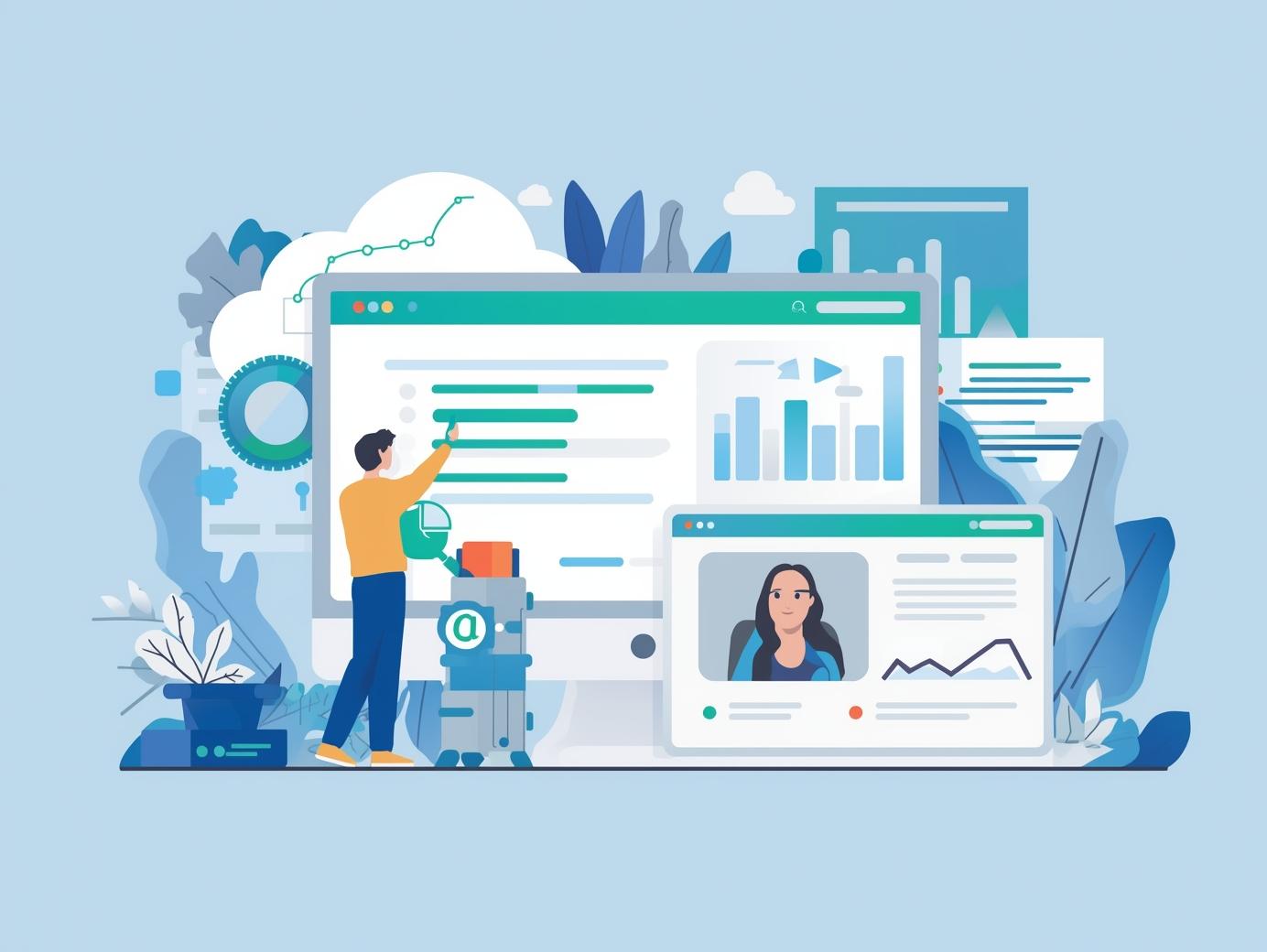
Illustration of custom software development process with developer analyzing data dashboard, charts, and web interface on computer screen
 

Custom software development is crucial for businesses operating in fast-changing digital environments, where customer expectations, security threats, and competition evolve rapidly. Off-the-shelf software often falls short by failing to meet the specific needs of a business, forcing teams to adapt their workflows to the software rather than the other way around.

It provides a solution by creating systems tailored to a company’s unique operations. This approach enhances efficiency, control, and scalability, allowing businesses to streamline processes and grow without being limited by generic software..

What Is Custom Software Development?

It is a process of designing and building software specifically for one organization. The solution is created around defined business goals, user requirements, operational processes and industry regulations.

Unlike ready-made platforms, custom solutions:

  • Focus only on the features your business truly needs
  • Remove unnecessary tools that complicate workflows
  • Offer full control over updates and system direction
  • Adapt as your company grows

Instead of paying for features you never use, you invest in a system built with purpose. The result is software that feels natural to your team and supports daily operations without friction.

Why Businesses Move Toward Custom Solutions

Companies usually consider custom software when growth, efficiency, and security become priorities. As operations expand, limitations of standard tools become more visible.

Alignment with Real Workflows

Every business has unique processes. Even companies in the same industry operate differently. Custom software reflects those differences.

When systems are built around your operations:

  • Manual work is reduced
  • Departments communicate more smoothly
  • Data flows without duplication
  • Bottlenecks become easier to identify and remove

This improves productivity without forcing teams to learn complicated workarounds.

Designed for Long-Term Growth

Growth often exposes the limits of generic tools. Subscription tiers increase. Features are locked behind upgrades. Integration becomes difficult.

Custom applications are designed to scale effortlessly. You can add new modules, optimize performance, and expand infrastructure as needed. The system evolves alongside your business, rather than restricting its growth.

Stronger and More Controlled Security

Security is not optional anymore. Data protection regulations are strict, and breaches can cause serious financial and reputational damage.

The system defines security architecture from the start, integrating access levels, encryption standards, authentication processes, and compliance requirements. This proactive approach strengthens security and mitigates potential vulnerabilities.

Better Integration Across Systems

Most businesses rely on multiple platforms. Accounting software, CRM tools, HR systems, marketing platforms, and payment gateways all need to communicate.

Custom software can be developed to integrate directly with:

  • Existing internal systems
  • Third-party APIs
  • Cloud services
  • Legacy databases

This creates a unified digital environment where information moves efficiently and accurately.

Industries That Rely on Custom Software Application Development

Custom software application development is not limited to one sector. Many industries depend on tailored systems because of operational complexity.
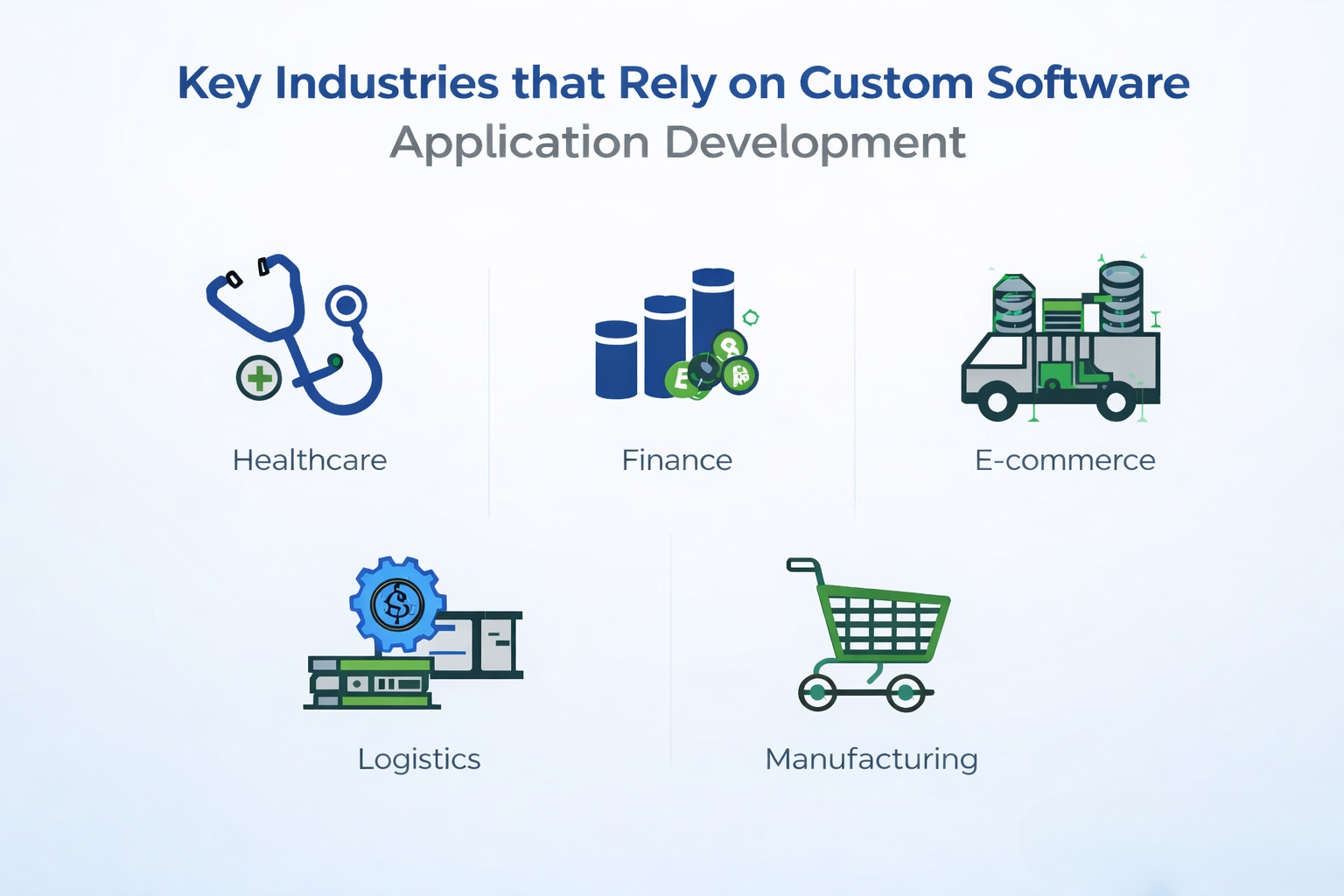
Infographic showing industries that rely on custom software application development including healthcare, finance, e-commerce, logistics, and manufacturing
Major industries leveraging custom software for operational efficiency and scalability.

Healthcare

Healthcare organizations manage sensitive patient data and strict compliance requirements. Custom systems support patient records, appointment scheduling, reporting tools, and secure communication channels. These systems must prioritize both usability and data protection.

Finance and FinTech

Financial institutions require accuracy, security, and reliability. Custom platforms help manage transactions, compliance tracking, fraud detection, and risk analysis. Because regulations change frequently, having adaptable software is a major advantage.

E-commerce and Retail

Retail businesses need systems that manage inventory, orders, customer accounts, and analytics in real time. Custom platforms make it easier to adjust pricing models, manage promotions, and analyze buying behavior without relying on rigid third-party limitations.

Logistics and Supply Chain

In logistics, visibility is everything. Tracking shipments, optimizing routes, managing warehouses, and generating reports all require connected systems. Custom development ensures that real-time data is accessible and accurate across the network.

Manufacturing

Manufacturing companies depend on precise planning and monitoring. Custom ERP systems, production tracking tools, and performance dashboards improve operational control and reduce downtime.

The Development Process

A structured development process ensures quality and long-term success. Skipping steps often leads to budget overruns or unstable systems.

1. Requirement Analysis

This stage focuses on understanding the business. Developers and stakeholders work together to define goals, technical needs, user roles, and expected outcomes. Clear documentation at this point prevents confusion later.

2. Planning and Architecture

Once requirements are defined, the technical blueprint is created. This includes selecting the technology stack, designing database structures, defining timelines, and outlining system architecture. Proper planning reduces risk during development.

3. UI and UX Design

User interface and user experience design ensure the system is easy to use. Wireframes and prototypes are created to visualize the product before development begins. A clean and intuitive interface reduces training time and increases adoption.

4. Development Phase

During development, engineers build the system following coding standards and security best practices. Many teams use Agile methodology, which means the software is delivered in phases. This allows regular feedback and gradual improvement.

5. Testing and Quality Assurance

Testing ensures stability and reliability. This includes performance testing, security checks, compatibility testing, and user acceptance testing. Identifying issues early saves time and cost in the future.

6. Deployment and Monitoring

After successful testing, the system is deployed to a live environment. Deployment includes server configuration, data migration, and system monitoring setup. A smooth launch is critical for business continuity.

7. Ongoing Maintenance and Improvement

Software is never truly finished. Updates, performance improvements, and security patches are necessary to maintain efficiency. Long-term support ensures the system continues to deliver value.

Core Software Development Services

Professional development companies provide a range of services tailored to business needs.

Web and Mobile Application Development
Custom applications are built for desktop and mobile environments thus ensuring accessibility across devices.

Enterprise Software Development
Large organizations require systems that support complex workflows and high user loads. Enterprise solutions focus on reliability and scalability.

Cloud-Based Solutions
Cloud-native development allows businesses to scale resources easily while improving accessibility and backup reliability.

API Development and Integration
APIs allow systems to communicate smoothly. Proper integration eliminates data silos and manual data transfers.

Software Modernization
Legacy systems can be upgraded without fully replacing them. Modernization improves speed, security, and compatibility with new technologies.

Choosing the Right Software Development Company in USA

Selecting a development partner is a strategic decision. The right company will understand both business logic and technical requirements.

When evaluating a provider, consider the following:

  • Proven experience in your industry
  • Strong technical expertise in modern frameworks and cloud platforms
  • Clear communication and structured documentation
  • An Agile development approach
  • Reliable post-launch support

The goal is not just to build software, but to build a long-term partnership.

Why Choose Qualix Solutions

Choosing the right partner directly impacts the outcome of your project. Qualix Solutions focuses on delivering business-oriented custom software solutions rather than generic technical builds.

The company follows a business-driven approach. Every project begins with understanding operational challenges and growth plans. This ensures that the final product supports measurable objectives.

Their development teams use modern, reliable technologies to build scalable and secure applications, with security practices implemented from the very first stage of architecture planning.

Qualix Solutions also provides end-to-end delivery. From requirement analysis to deployment and long-term support, all stages are managed under one structured process. This reduces communication gaps and improves project efficiency.

As a trusted software development company in the USA, Qualix Solutions helps businesses turn ideas into practical systems that improve operations and support growth.

Long-Term Business Impact
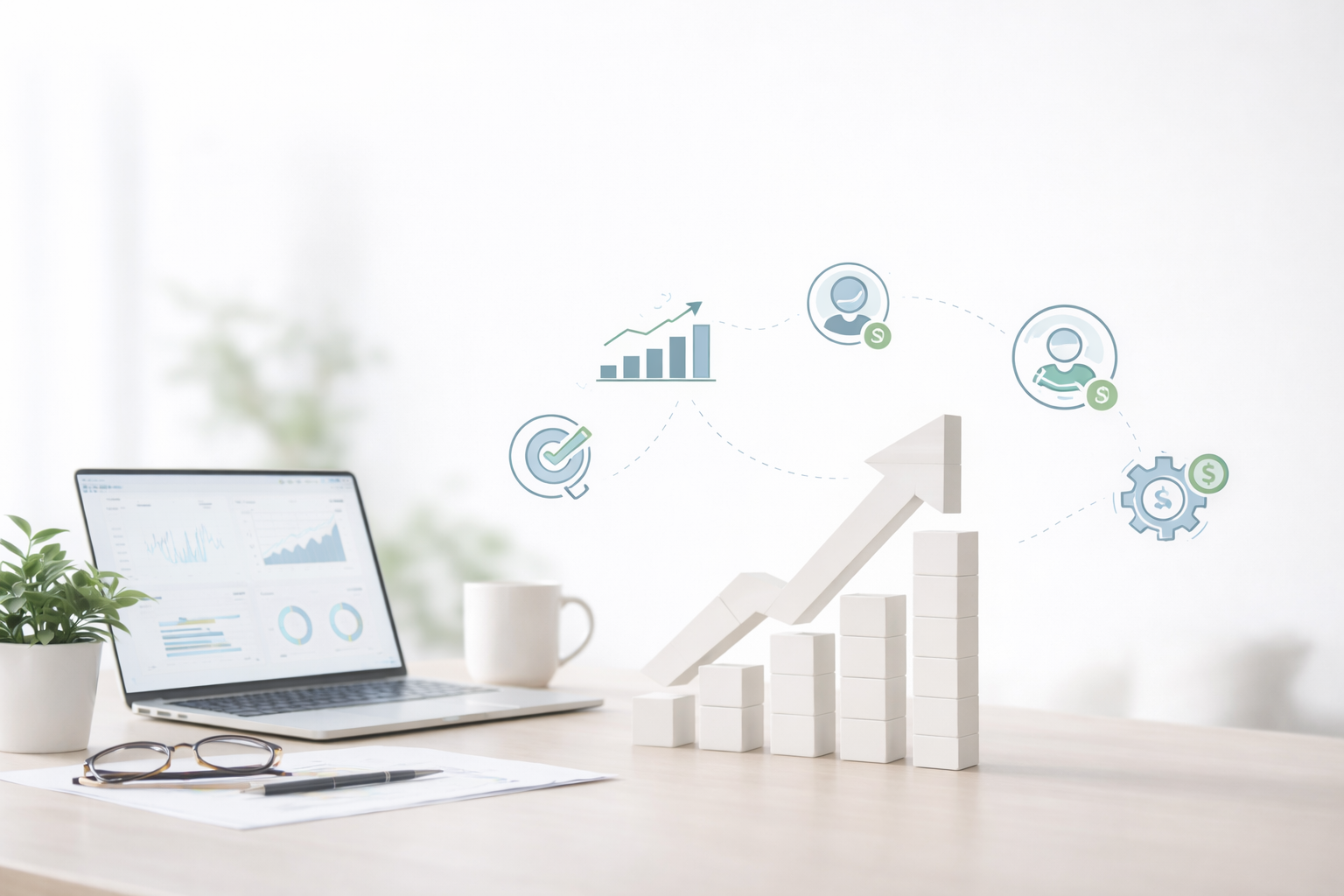
Laptop showing analytics dashboard next to a rising growth chart and business finance icons representing productivity and reporting improvements

Custom software is not just about technology. It directly affects operational performance.

Businesses often see improvements in:

  • Productivity and workflow efficiency
  • Data accuracy and reporting visibility
  • Customer experience
  • Decision-making speed
  • Cost control over time

When systems are aligned with strategy, teams work more effectively. Leaders gain clearer insights through customized dashboards and analytics tools.

Final Thoughts

Developing software gives businesses control over their technology. Instead of adapting to the limits of generic platforms, companies can build systems designed specifically for their needs.

While the initial investment may be higher than purchasing ready-made tools, the long-term advantages are significant. For instance, tailored software improves efficiency, strengthens security, supports scalability, and reduces dependency on external vendors.

Furthermore, by working with an experienced partner like Qualix Solutions, businesses can confidently develop scalable software solutions that not only support present operations but also accommodate future expansion.

FAQs

What is custom software development for companies?

It creates solutions tailored to a business’s specific needs, offering enhanced control and flexibility. Unlike off-the-shelf software, it adapts to the company’s processes and objectives for greater efficiency.

Why is custom software development important today?

It is crucial today as it ensures technology is perfectly aligned with a business’s unique operations, boosting efficiency. Additionally, it provides flexibility to scale and adapt to growth, market shifts, and evolving security requirements.

How much does custom software development cost to maximize the business?

The cost depends on factors such as project scope, functionality, and technical complexity. While investment levels vary, well-planned custom software delivers measurable long-term value through efficiency, automation, and reduced dependency on multiple tools.

How long does the custom software development process take?

The development process typically takes anywhere from a few weeks to several months, depending on project scope, features, and complexity. Timelines may vary based on requirements, integrations, and testing needs.

Does custom software integrate with existing systems without any interruption?

Yes, custom software is designed to integrate with existing systems using tested integration methods and staged deployment. This approach minimizes risk and helps maintain uninterrupted business operations.

 

Relevant Guides & Services

.Net Development Company

Custom Web Development

AI and ML Development Solutions

Mobile App Development

UI/UX Design

Next.JS Development Company

Tags

What do you think?

Leave a Reply

Your email address will not be published. Required fields are marked *

Related articles

what is software development

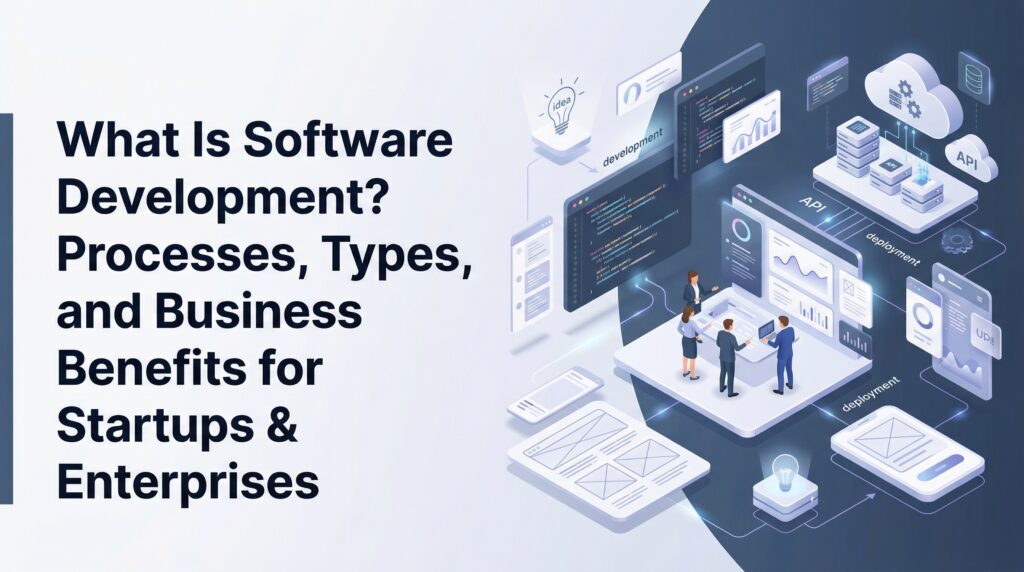
What Is Software Development? Processes, Types, and Business Benefits for Startups & Enterprises

Is your company’s digital infrastructure merely keeping the lights on, or is it engineered to drive explosive growth? Software development drives one of the fastest-growing sectors in the global economy. Industry reports from Grand View Research estimate the market at over $730 billion in 2024, with projected growth exceeding $1.3 trillion by 2030 at an annual rate of more than 11%. For organizations across the United States, mastering this lifecycle is non-negotiable. It turns vague ideas into precise, functional tools that meet specific business goals and user demands. Modern teams rely on structured frameworks, like the Software Development Life Cycle (SDLC). These interconnected steps ensure every line of code serves a strategic purpose. By leveraging agile methodologies and continuous testing, businesses build scalable, secure systems. These systems deliver long-term value and a formidable competitive edge. This guide breaks down the core processes, various application types, and tangible benefits professional software development brings to ambitious companies. The increasing reliance on software across industries, from cloud computing to artificial intelligence, continues to drive massive global investment, with enterprise software spending expected to approach $1 trillion annually, according to data from Statista. Key Takeaways Software development is a structured process for creating and maintaining digital applications. It powers a massive and rapidly growing global economy. A defined lifecycle (SDLC) is crucial for aligning technical work with business strategy. Modern methodologies help build scalable and secure systems for the future. Professional development transforms digital infrastructure into a key driver of business value. Understanding different software types is essential for selecting the right solution. The ultimate goal is to create efficient tools that meet specific user and organizational needs. Introduction to Software Development The modern business landscape is fundamentally shaped by programmable systems that operate independently of physical machines. These digital instructions form the backbone of everything from utility grids to personal devices. This foundational layer enables the creation of tailored applications. Companies leverage these tools to carve out unique market positions. Setting the Stage for Digital Innovation Digital innovation thrives on automation. Complex tasks are handled by code, allowing operations to scale efficiently. Manual labor costs no longer rise proportionally with growth. This efficiency drives the current 11.7% annual market growth in the United States. The Role of Software in Modern Business Modern enterprises use applications to integrate disparate systems. Seamless data flow between departments boosts organizational efficiency. The role of these programs has evolved. Simple utilities have become complex, cloud-native ecosystems supporting millions of businesses daily. Aspect Traditional Approach Software-Driven Approach Primary Impact Data Management Manual filing, spreadsheets Centralized databases, real-time analytics Faster, accurate decisions Process Automation Repetitive human tasks Automated workflows, bots Lower costs, higher output Customer Interaction In-person, phone calls 24/7 digital portals, apps Improved service, global reach This shift underscores why professional software development is critical. It transforms static infrastructure into a dynamic engine for value creation. What is Software Development: Definition and Scope The global demand for digital solutions underscores the importance of a well-defined creation process. This field involves the comprehensive steps of defining, building, testing, and maintaining applications. It supports a market valued at $429 billion. Understanding the Core Concepts Software engineers and developers collaborate closely. They translate complex business needs into functional code. The final product must align with user expectations. The scope of this work is broad. It includes system, application, and embedded programs. Each type requires specialized programming languages and tools. Effective planning and requirements management are critical. Teams define the project scope before writing a single line. This upfront work prevents costly changes later. Type Primary Function Common Tools & Languages Typical Use Case System Software Manages hardware and basic operations C, C++, Assembly Operating systems, drivers Application Software Performs specific tasks for users Java, Python, JavaScript Web apps, mobile apps, business tools Embedded Software Controls dedicated hardware devices C, Rust, specialized IDEs Medical devices, automotive systems A structured approach ensures products are secure and maintainable. This methodology delivers long-term value throughout the entire lifecycle. The Software Development Lifecycle (SDLC) Explained A structured framework guides every successful project from initial concept to long-term support. This lifecycle, known as the SDLC, provides a roadmap for teams to build robust applications. It standardizes the development process to enhance quality and manage risk. Following these phases ensures the final product aligns with business goals. SDLC Stages: Planning to Maintenance The software development process typically involves seven key phases: Planning: Defining project scope and objectives. Analysis: Gathering detailed requirements. Design: Creating system architecture. Implementation: Writing the actual code. Testing: Identifying and fixing bugs. Deployment: Releasing the application to users. Maintenance: Providing updates and support. Each stage feeds into the next, creating a logical flow. Software engineers rely on this sequence to embed security and scalability early. Best Practices and Process Optimization Modern teams integrate continuous testing throughout the lifecycle. This approach catches defects long before deployment. Regular feedback loops with stakeholders are crucial. They ensure the product evolves according to user needs. Standardizing the deployment maintenance cycle leads to predictable outcomes. It also helps developers meet regulatory requirements efficiently. Comparing Development Methodologies The 2001 Agile Manifesto marked a pivotal shift in how engineers approach complex projects. Teams now select from several established models to guide their work. Each framework offers distinct advantages for managing scope, risk, and delivery. Agile vs Waterfall: Key Differences and a Comparison Table The Waterfall model is a linear, sequential approach. Each phase, like planning or design, must finish before the next begins. This method suits projects with highly stable, well-defined requirements. Changes later in the process are difficult and costly. Agile methodology prioritizes flexibility and customer feedback. Work occurs in short, iterative cycles called sprints. This allows teams to adapt quickly to new information or shifting priorities. It is ideal for dynamic environments. Aspect Waterfall Model Agile Methodology Ideal Project Type Approach Linear & Sequential Iterative & Cyclical Waterfall: Stable specs. Agile: Evolving needs. Flexibility Low; changes are costly High; adapts each sprint Waterfall: Fixed contracts. Agile: Market-driven. Customer Involvement Mainly

Read more
food delivery bicycle courier passing urban restaurant

Food Delivery Companies Payment Comparison 2026

The food delivery industry has grown explosively over the last decade, transforming how millions of people dine and how restaurants operate. Platforms such as DoorDash, Uber Eats, Grubhub, and Postmates (now integrated into the Uber Eats ecosystem) serve as intermediaries that connect hungry customers with local restaurants and independent drivers. However, food delivery companies’ payment structures can be complex. Understanding restaurant commissions, customer fees, payment terms, and real net revenue is essential whether you’re a restaurant owner evaluating profitability or a customer trying to save money. In this food delivery companies payment comparison, we’ll break down how each platform charges, how revenue flows to restaurants, and how customers are billed, including nuances often overlooked in simpler summaries. Key Factors to Consider in Food Delivery Payment Comparisons Before diving into the best food delivery companies payment comparison, it’s important to understand the core variables that affect costs for both restaurants and customers: Restaurant Commissions: Third‑party delivery apps typically charge restaurants a percentage of the order total as commission. These can vary based on plan type and negotiated contract. Processing & Operational Fees: In addition to base commission rates, many platforms charge processing or payment‑related fees, which can further reduce restaurant net revenue. Delivery & Service Fees for Customers: Customers pay delivery fees, service fees, small‑order fees, and sometimes surge pricing during peak times. These vary widely by location and order details. Payout Terms: The timing and method by which restaurants receive payout (weekly, daily advance, or accelerated for a fee) impacts cash flow. Marketing & Promotion Fees: Optional promotional services — such as enhanced visibility or priority listing — can increase a restaurant’s overall cost. 1. Delivery Service Fees: How Much Are They Really Understanding how food delivery platforms charge both restaurants and customers requires moving beyond flat estimates into more realistic ranges based on industry data. DoorDash Restaurant Commissions: Typically around 15 %–30 % per order, depending on which merchant plan the restaurant selects and any promotional add‑ons.  Additional Costs: Optional fees for marketing or enhanced placement can further increase costs.  Customer Fees: Delivery and service fees vary significantly by city, market conditions, and order size.  Payout Options: Restaurants generally receive payouts on a regular schedule, often weekly, but accelerated payout options may be available. Takeaway: DoorDash’s pricing is variable and context dependent, while commission percentages are broad, actual restaurant costs are shaped by contractual choices and optional services. Uber Eats Restaurant Commissions: Generally within a 15 %–30 % range, though some platforms or plans may have tiered fees depending on services chosen. Processing Fees: Some platforms additionally charge processing fees separate from commissions. Customer Fees: Delivery and service fees vary by region and can adjust with promotions or dynamic pricing.  Payout Terms: Typically weekly or at a schedule defined in merchant contracts. Note: Because Uber Eats has a wide global footprint and diverse plan options, exact costs can differ between markets and individual agreements. Grubhub Restaurant Commissions: Grubhub has been known to offer greater flexibility in commission rates. Some plans range from 5 % to 20 % for its marketplace option or a fixed lower rate for direct orders. Processing Fees: May include order processing charges that reduce net income.  Customer Fees: As with other platforms, delivery and service fees vary by region and time of day.  Payout Terms: Weekly or negotiated based on partnership agreements. Takeaway: Grubhub’s structure can be more flexible than others, especially for restaurants that bundle delivery with direct order services. Postmates (Now Integrated with Uber Eats) Restaurant Commissions: Since becoming part of the Uber Eats ecosystem, Postmates typically aligns with Uber Eats pricing structures. Customer Fees: Similar to Uber Eats, with variability based on market factors.  2. Are Delivery Platforms Always Cheaper for Customers There is no single cheapest food delivery app, as costs can vary greatly depending on the location, restaurant partnerships, and the specific items ordered. Real‑World Pricing Variability Data suggests that which app is cheapest depends heavily on location, restaurant partnerships, and the specific items ordered: A recent analysis found that Grubhub was the lowest‑cost option in most U.S. states when comparing popular fast‑food menu items. However, in some metropolitan areas and specific chains, DoorDash and Uber Eats can be cheaper. Overall, dynamic fees and promotions mean price comparison at checkout is the only way to know which is cheapest for a particular order. Why Costs Vary Menu prices: Restaurants may price items differently across platforms. Delivery & service fees: These can change with surge demand and time of day. Promotions & subscriptions: Loyalty programs may reduce or waive fees. Ultimately, order totals can vary significantly even for the same restaurant and the same meal, so customers should compare options before finalizing an order. 3. What Do Restaurants Actually Earn from Delivery Restaurants generally have lower profit margins on delivery orders than on dine‑in due to the added commissions and fees. Typical Profit Impact Most third‑party platforms charge 15 % to 30 % commission fees on delivery orders.  After additional processing and marketing fees, real net margins on delivery orders can shrink substantially, some industry analyses suggest margins fall to 5 %-10 %, much lower than typical dine‑in margins. This means that while delivery orders can boost sales volume and reach new customers, they often deliver less net profit compared to dine‑in sales. Negotiated Rates High‑volume restaurants may negotiate lower commission rates — for example, 18 % to 22 % — especially when they bring significant order volume to a platform.  Hidden and Indirect Costs Some industry analysts suggest that when factoring in all indirect costs such as payment processing, order handling, and channel marketing, the effective cost of delivery to a restaurant can exceed the advertised commission rate.  4. Restaurant Payout Frequency & Cash Flow Payout timing varies by platform and by merchant agreement: Weekly payouts are common. Accelerated or daily payouts may be available for an additional fee or as part of premium plans. Some services offer adjusted payout terms for high‑volume partners. Faster payout options can help restaurants manage cash flow but may come at a cost. 5. Marketing, Promotions

Read more
UI/UX design for business growth in 2026 featuring professionals working on user interfaces, smartphone mockups, wireframes, and growth trend graphs

UI UX Design Services for Business Growth in 2026

In 2026, users judge your business long before they speak to your team. They judge it by how your website, app, or digital product feels to use. If the experience is confusing, slow, or frustrating, they often leave permanently. This is why UI UX design services are no longer optional for businesses that want sustainable growth. UI and UX design directly influence conversions, customer retention, brand trust, and operational efficiency. Businesses that treat design as a strategic function outperform those that treat it as decoration. UI/UX Design From a Business Perspective UI and UX design are often discussed from a creative angle, but their real value lies in business impact. UX (User Experience) focuses on how users move through a product, complete tasks, and achieve goals. UI (User Interface) focuses on how those interactions look, feel, and respond visually. Professional ui and ux design services bring these two disciplines together to reduce friction, improve clarity, and guide users toward action. Practical UI/UX Experience That Drives Results At Qualix Solutions, UI/UX design is shaped by hands-on experience working with real products, real users, and real constraints. Our team designs interfaces for websites, mobile applications, SaaS platforms, and enterprise systems where usability directly affects revenue and adoption. This experience helps us design interfaces that solve problems instead of just following trends. Every design decision is tied to user behavior, technical feasibility, and measurable business outcomes. The Difference Between UI and UX Design A common question businesses ask is what is the difference between UI and UX design, especially when planning a new product. Difference Between UI and UX With Example Consider an online banking app: UX design defines how users check balances, transfer money, and manage accounts efficiently. UI design determines how buttons, colors, typography, and layouts make those actions clear and easy to use. Good UX without UI feels functional but dull. Good UI without UX looks attractive but frustrates users. Growth happens when both work together. Why UI/UX Design Matters More Than Ever in 2026 User expectations in 2026 are shaped by the best digital products they use daily. Anything below that standard feels broken. Strong ui ux design and development services help businesses achieve: Higher Conversions Clear flows, intuitive layouts, and reduced friction lead users toward decisions instead of confusing them. Better Retention Users stay with products that feel predictable and easy. UX builds habits; UI reinforces trust. Lower Support Costs Well-designed experiences reduce user errors, confusion, and support requests. Stronger Brand Credibility Professional design signals reliability and attention to detail without saying a word. What Does a UX/UI Designer Actually Do Many stakeholders still ask, what is a ux/ui designer and what value they bring. A professional ux ui designer is responsible for: Understanding user needs and behavior Designing user journeys and interaction flows Creating wireframes and prototypes Collaborating with developers and product teams Testing and refining designs based on real feedback Experienced ui and ux designers balance user needs, business goals, and technical constraints throughout the product lifecycle. UI/UX Design Trends Shaping Business Growth in 2026 The design trends for 2026 are shifting the focus away from visual novelty and placing more emphasis on usability and performance. As businesses evolve, it’s becoming increasingly clear that effective user interfaces (UI) and experiences (UX) are no longer just about looking good—they need to work well and perform seamlessly. Key UI/UX design trends include: Simpler Interfaces with Fewer Distractions: In 2026, there is a growing emphasis on creating minimalist designs that eliminate unnecessary elements. This approach enhances the user experience by allowing users to focus on essential tasks without being distracted by extraneous content or features. Accessibility-First Design for Broader User Reach: Accessibility has become a top priority, with more businesses designing products that cater to a wide range of users, including those with disabilities. By incorporating accessibility features, businesses can ensure a more inclusive digital experience and expand their reach to a broader audience. Data-Driven UX Decisions: Making informed design choices based on real user data is a crucial trend. Businesses are increasingly relying on data analytics to understand user behavior and optimize their designs for maximum engagement and satisfaction. Consistent Experiences Across Devices: The need for a seamless experience across multiple devices is a priority. Whether users are accessing a website on a desktop, smartphone, or tablet, ensuring consistency in design and functionality is key to keeping them engaged. Performance-Focused Layouts That Load Fast: Fast load times are critical in retaining users. Performance-driven design ensures that websites and applications load quickly, reducing bounce rates and improving user satisfaction. In conclusion, trends matter only when they contribute to usability. Design choices made without a clear purpose rarely deliver tangible results, making it essential to prioritize functionality and performance over aesthetics alone. The Role of Figma in Modern UI/UX Design Collaboration is critical in modern product teams. Figma for UI/UX design has become widely adopted because it supports real-time collaboration between designers, developers, and stakeholders. Figma helps teams prototype quickly, maintain consistent design systems, share feedback instantly and reduce gaps between design and development Using the right tools improves both speed and design quality. UI/UX Design Services vs DIY Design Approaches Some businesses rely on templates or internal teams to save costs. While this can work short term, it often limits scalability. Professional ux/ui design services provide: Research-driven design decisions Custom solutions aligned with business goals Scalable design systems Designs that translate cleanly into development DIY approaches often lead to usability issues that surface only after launch, when fixing them becomes expensive. UI and UX Design Services for Different Business Stages Different business stages require different design strategies. Startups Startups benefit from UX-focused MVPs that validate ideas quickly and avoid unnecessary features. Growing Businesses Scaling companies need consistent design systems that work across products and platforms. Enterprises Large organizations rely on ui ux design and development services to manage complex workflows, security requirements, and large user bases. Custom design adapts to business complexity rather than forcing businesses into rigid

Read more
Contact us

Partner with Us for Comprehensive IT

We’re happy to answer any questions you may have and help you determine which of our services best fit your needs.

Your benefits:
What happens next?
1

We Schedule a call at your convenience 

2

We do a discovery & consulting meeting 

3

We prepare a proposal 

Schedule a Free Consultation