The unforeseen requirement:
- HIPAA surfaced mid build.
- PHI masking, tamper proof login, audit and change logs, retention rules for audio and transcripts.
- BAA contracts with every external API.
This reshaped the security posture, not just one feature.


Docucoder captures the procedure in real time and delivers a ready to review, CPT coded surgical report by the end of the case. No paperwork relay, no lost detail.

docuCODER takes time to bill from an industry average of 3 to 7 days down to zero. Surgical documentation is complete the moment the procedure ends.
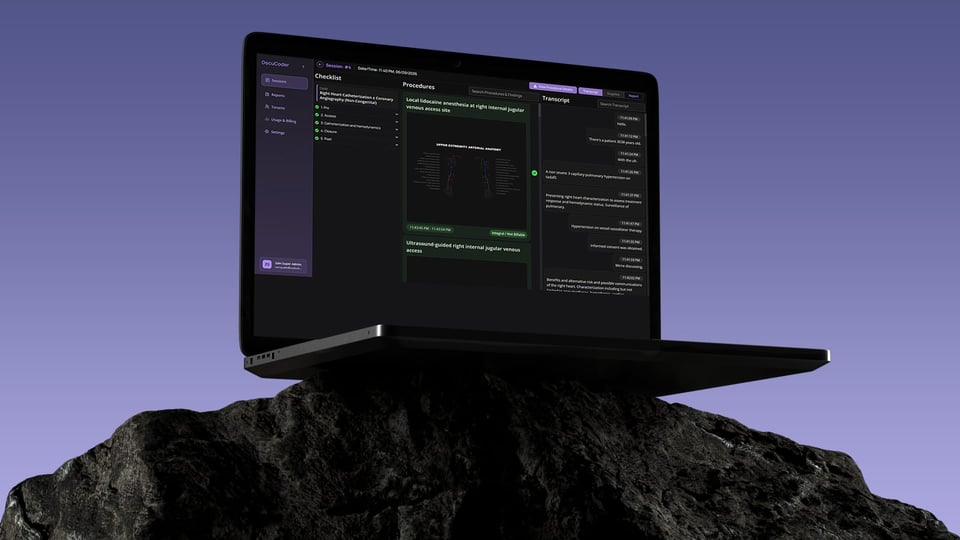
The detail that sets the CPT code is generated by the physician mid procedure, but captured and coded later, by different people. Every handoff drops detail, and in interventional coding a dropped detail (laterality, device, anatomical site, supply) is the difference between the correct code and a rejected bill. On top of that sits the cognitive load of holding the procedure in memory while documenting it, then carrying that same mental tax into coding the bill.
Three pain points
Real dollars lost per procedure from undercoding
Slower approvals from incomplete context
Mental tax on three people reconstructing intent
Did you know?

American hospitals lost $68 billion in 2022 from billing mistakes, wrong codes, rejected claims, and lost payments.
Revenue leakage from coding errors can reach 10 to 15% of a practice's annual earnings. For a $10M practice, that's $1M to $1.5M lost every year.
Roughly 80% of U.S. medical bills contain at least one error, whether an incorrect code, a duplicate charge, or missing information.
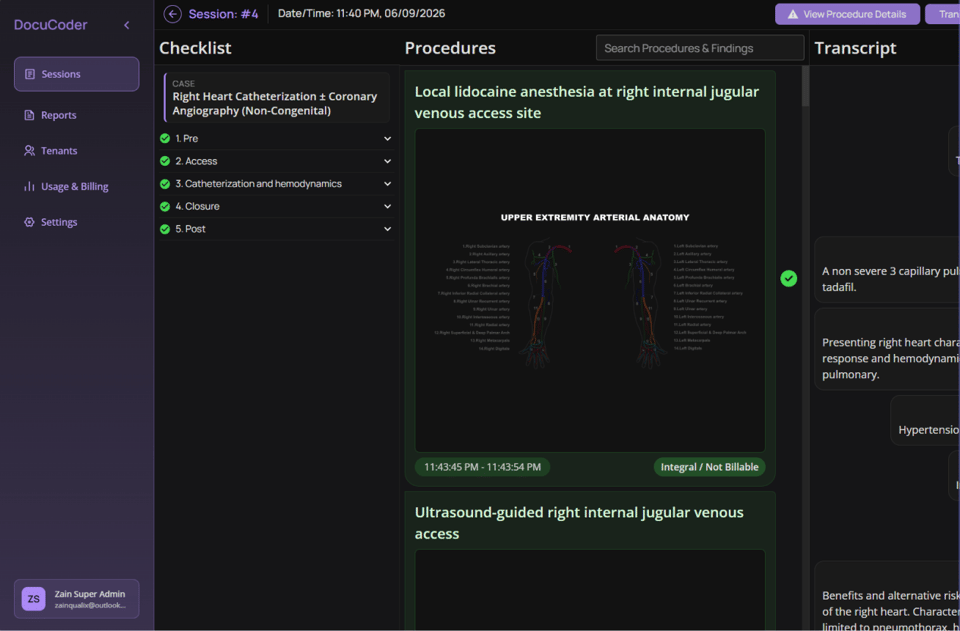
The physician does the one thing they already do, which is talk through the procedure. While they talk, the case resolves itself on screen. Procedures get recognised and matched to the hospital's own coding rules, missing billable elements surface as live flags, and supplies are scanned in on the spot. By the time the case ends, the coded, defensible record is essentially done.
The relay collapses into one continuous session because there's no handoff to survive. It's built as a chain of agents working off the physician's voice, with a human scriber in the loop clearing flags.
speech to timestamped text
procedure vs chatter
against hospital rules
flags missing elements
lot, mfr, recall scan
scriber clears flags
This reshaped the security posture, not just one feature.

Walk out of the room with a coded, billable, defensible record instead of a pile of notes someone else has to decode days later. Output quality compounds. The first report versus the hundredth, as tenant specific onboarding carries the surgeon's voice into the final code.

Post launch demand expanded the product. A CPT coded report request from a coder, CPT 2026 cardiac regs, an AI next steps checklist, supply recall vision alerts, and charge sheet generation. People asking for more is the trust signal.


A role based ERP that put procurement, inventory, budgets and approvals for a multi site construction firm into one platform, from the C suite to the job site.